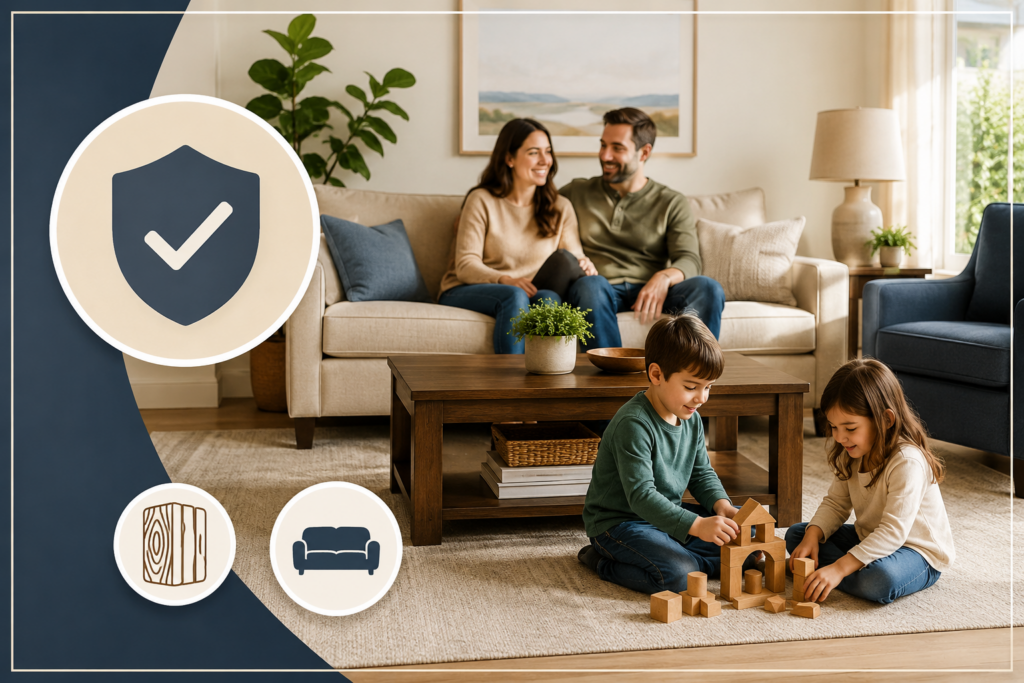
The average sofa in a high-use family home lasts 7 to 8 years. A well-built one lasts 10 to 15. The difference is not luck or gentle use. It comes down to decisions made at the point of purchase: frame material, joinery method, cushion density, and fabric performance. These details determine whether a piece ages gracefully under daily family life or starts sagging, creaking, and pilling within a few seasons.
This guide breaks down what to look for, what to test in person, and which pieces in your home deserve the largest share of your furniture budget.
Start With the Frame
The frame is the skeleton of any upholstered piece. Everything else, cushions, fabric, suspension, attaches to it and depends on it for structural integrity.
Solid hardwood frames made from oak, walnut, maple, or ash handle years of shifting weight, kids climbing, and daily sitting without loosening. Kiln-dried hardwood is the standard to look for because the drying process removes moisture that causes warping and cracking over time. A heavier sofa or chair typically signals a stronger internal frame.
Avoid frames made from particleboard, MDF, or softwoods like pine in large pieces such as sofas, sectionals, and bed frames. These materials compress under repeated stress and lose structural integrity within a few years. They cost less upfront but fail sooner, which makes them more expensive per year of actual use.
For dining tables, desks, and shelving, solid wood construction remains the most reliable long-term choice. A solid timber dining table with a simple leg design and an oil-based finish can withstand decades of meals, homework, and family gatherings.
Check the Joinery Before the Price Tag
Furniture fails at connection points first. The way rails, legs, and panels attach to one another determines how long a piece stays tight and stable.
Dovetail joints, where interlocking wedge-shaped cuts hold two boards together without fasteners, are the strongest option for drawers and case goods. Mortise and tenon joints, where a protruding tongue fits into a carved slot, provide the best strength for tables and chair frames. Both methods distribute stress across a wide surface area rather than concentrating it at a single point.
Corner blocks, metal brackets, and screws at stress points add reinforcement. Look for these details by flipping chairs upside down or pulling drawers out to inspect the back and bottom.
Construction that relies only on glue and staples is a warning sign. These joints loosen under vibration and weight changes. If a piece wobbles in the showroom, it will only get worse at home.
Pick Fabrics That Handle Daily Life
Families with children or pets need upholstery that resists staining, withstands friction, and cleans without professional intervention.
Performance fabrics are engineered for exactly this. Look for labels that specify stain resistance, high abrasion counts (measured in double rubs, with 30,000 or higher considered heavy-duty), and colorfastness ratings. Crypton, Sunbrella, and Revolution are common performance fabric brands used in residential furniture.
Mid-tone colors and textured weaves hide wear better than solid light fabrics. A charcoal herringbone or an oatmeal linen-look shows less staining and pilling over time compared to pure white or jet black.
Full-grain leather is another strong option for families. Unlike bonded leather or faux alternatives, full-grain leather softens and develops character with use rather than peeling or cracking. It cleans easily with a damp cloth and handles spills better than most people expect.
Test Cushions and Suspension in Person
Cushion fill and the suspension system beneath it are the two factors most responsible for long-term comfort. Both degrade invisibly until the damage is already done.
High-density foam retains its shape under daily use. Low-density foam costs less but compresses permanently within a year or two, leaving visible body impressions. The best cushion construction wraps high-resilience foam in a layer of fiber or down-alternative fill, which adds softness on the surface without sacrificing support underneath.
Test this in the store. Press a seat cushion down firmly, then release. If it bounces back slowly to its full height, the foam density is adequate. If it stays compressed or returns with a visible dip, move on.
Beneath the cushions, the suspension system matters equally. Eight-way hand-tied springs are the premium standard. Each spring is individually attached to the frame and tied to surrounding springs in eight directions, distributing weight evenly across the entire seat. Sinuous (S-shaped) springs offer acceptable support at a lower price point. Webbing-only construction is the weakest option and tends to sag within a few years under regular family use.
Listen for creaking when you sit and shift your weight. Noise in the showroom means loose connections that will worsen at home.
Choose Timeless Shapes Over Trendy Ones
A furniture piece that lasts 15 years needs to look right for most of those years. Trend-driven silhouettes date quickly. The ultra-low, armless sofa that looks current today may feel awkward in a living room five years from now.
Classic profiles, a straight-arm sofa, a Parsons dining table, a slat-back chair, remain visually neutral across changing trends. They serve as a stable foundation that you update with smaller accessories: throw pillows, table runners, art, and lighting.
Neutral finishes on large pieces extend their visual lifespan. A walnut dining table or a gray linen sectional adapts to whatever color palette surrounds it. Save bold colors and experimental shapes for accent chairs, side tables, and decorative objects that cost less to replace when your taste evolves.
Modular furniture adds practical longevity. A sectional sofa with rearrangeable components fits a small apartment now and a larger family room later. An extendable dining table serves weeknight dinners for four and holiday gatherings for ten. These pieces survive lifestyle changes and moves because they adapt rather than lock you into a single layout.
Know Which Pieces Deserve the Investment
Not every piece of furniture needs to last a lifetime. Directing your budget toward the items your family uses hardest produces a better result than spreading it evenly across every room.
The cost-per-year calculation clarifies this. A solid wood dining table at $2,000 that lasts 20 years costs $100 per year. A particleboard alternative at $400 that needs replacing every 3 years costs $133 per year and produces more waste.
Pieces worth the highest investment, ranked by daily use and structural demand:
Sofas and sectionals absorb the most wear in most homes. A family of four logs thousands of sitting hours per year. Invest in frame, suspension, and fabric here first.
Dining tables take sustained weight, moisture from spills, and surface abrasion from plates, cups, and elbows. Solid wood with a protective finish handles all of this for decades.
Bed frames support body weight for eight hours nightly. Solid timber or steel frames with strong slats and minimal moving parts outlast engineered wood alternatives and creak less over time.
Storage and shelving need structural integrity to handle weight safely over years. Solid wood bookshelves and properly mounted floating shelves hold heavier loads than MDF equivalents without bowing.
Pieces where budget options work fine: decorative side tables, accent chairs used occasionally, seasonal outdoor cushions, and trend-driven decor items. These carry less structural demand and change more frequently with evolving taste.
Care for What You Buy
Durable construction gives furniture the potential to last. Maintenance determines whether it actually does.
Rotate sofa and chair cushions monthly to distribute wear evenly. Flip reversible cushions and swap seat positions so the same spot does not take all the compression.
Tighten screws and bolts on tables, chairs, and bed frames once a year. Joints loosen gradually from vibration and weight shifts, and catching them early prevents structural damage.
Keep wood surfaces away from direct sunlight, which causes fading and drying over time. Use coasters and trivets to prevent heat rings and moisture marks. When the finish dulls or feels dry, apply the appropriate wood oil or wax to restore protection.
Vacuum upholstered furniture regularly to remove dust and grit that wear down fabric fibers from within. Address spills immediately by blotting, never rubbing, and follow the manufacturer’s cleaning code (W for water-based cleaners, S for solvent-based, WS for either).
Use felt pads under furniture legs on hard floors to prevent scratching. On carpeted floors, furniture cups distribute weight and prevent permanent indentations.
Small maintenance steps cost minutes per month. Replacing a neglected piece costs hundreds or thousands of dollars.
Frequently Asked Questions
How long should quality furniture last?
A well-built sofa with a kiln-dried hardwood frame and high-density foam cushions lasts 10 to 15 years with regular use. Solid wood dining tables and bed frames routinely last 20 years or more. The key factors are frame material, joinery method, and consistent basic maintenance like cushion rotation and annual hardware tightening.
What is the most durable furniture material for families?
Solid hardwoods (oak, walnut, maple, ash) are the most durable frame and surface materials. For upholstery, performance fabrics with abrasion ratings above 30,000 double rubs handle heavy family use. Full-grain leather is another strong option because it softens with age rather than degrading.
Is expensive furniture always better quality?
Not necessarily. Price reflects brand positioning and retail margins alongside construction quality. A $3,000 sofa from a designer brand may use the same particleboard frame as a $600 budget option. Check the frame material, joinery, cushion density, and suspension system rather than relying on price as a proxy for durability.
What type of sofa is best for families with kids?
Look for a sofa with a kiln-dried hardwood frame, eight-way hand-tied or sinuous spring suspension, high-density foam cushions, and performance fabric upholstery. Removable, washable cushion covers add practical value. Mid-tone colors and textured weaves hide stains and wear better than solid light fabrics.