
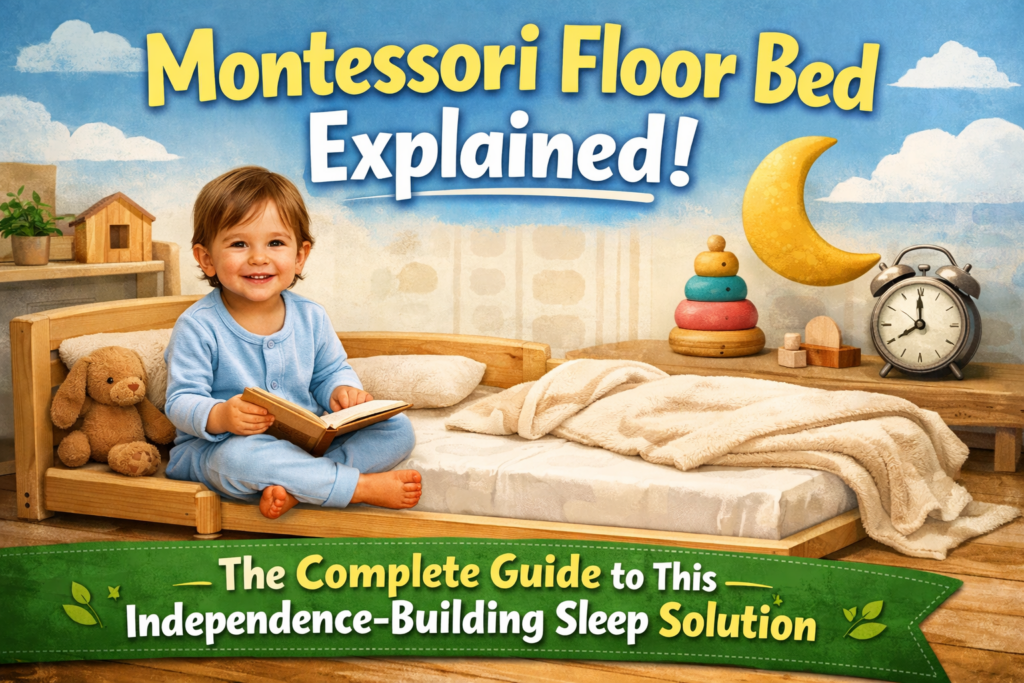
My daughter was 14 months old when she started climbing out of her crib. Each morning became a rescue mission, rushing to her room after hearing that terrifying thud, finding her standing triumphantly on the floor while my heart pounded out of my chest. That’s when a friend mentioned something that would completely change our sleep journey: “Have you considered a floor bed?”
I hadn’t. The idea of my toddler sleeping on a mattress on the floor seemed almost counterintuitive. Weren’t cribs supposed to keep babies safe? But as I dove deeper into the Montessori approach to sleep, I discovered a philosophy that had been empowering children toward independence for over a century—and it was exactly what our family needed.
If you’ve stumbled upon the term “Montessori floor bed” and found yourself intrigued yet confused, you’re not alone. This comprehensive guide will walk you through everything you need to know about this increasingly popular sleep solution, from its philosophical roots to practical safety guidelines.
What Is a Montessori Floor Bed?
A Montessori floor bed is a child-friendly, low-to-the-ground sleeping setup in which the mattress is placed directly on the floor or on a minimal, shallow bed frame that sits only a few inches above the ground.
Unlike a traditional crib, which is designed with tall rails and an enclosed structure that limits movement, a floor bed is fully open and accessible, allowing children to climb in and out on their own. This simple design supports independence, freedom of movement, and self-directed routines, which are core principles of the Montessori approach.
But it’s so much more than just a mattress on the floor.
The Montessori floor bed represents a fundamental shift in how we think about children’s sleep environments. Instead of a contained space designed primarily for adult convenience, it creates a child-centered bedroom that respects a child’s natural drive toward independence and exploration.
The design typically features:
- A firm mattress (often a standard crib mattress for younger children)
- No barriers or railings restricting movement
- Low height to minimize any fall risk
- Accessibility that allows a child to enter and exit freely
Some families use a simple frame, often made of wood, to keep the mattress slightly elevated for airflow. Others place the mattress directly on the floor. Both approaches are considered authentic to the Montessori philosophy—what matters most is the accessibility and freedom it provides.
The Philosophy Behind the Floor Bed: What Maria Montessori Actually Said
Dr. Maria Montessori, the Italian physician and educator who developed the Montessori method in the early 1900s, had strong opinions about children’s sleeping arrangements—even if she never used the term “floor bed” specifically.
In her book The Secret of Childhood, Montessori observed:
“The design of the home environment is tied to the protection of the adult’s sleep, not always keeping the child’s own needs and desire in mind.”
She challenged the conventional wisdom that children should be confined during sleep, writing:
“Who would deny that children need sleep? But if a child is so alert, so capable of observation, he is not primarily a sleeper.”
This wasn’t a dismissal of children’s need for rest—rather, it was a recognition that children shouldn’t be forced to stay confined longer than their bodies require. Given the freedom to self-regulate, Montessori believed children would naturally learn to manage their own sleep needs.
In her 1946 London Lectures, Montessori specifically recommended: “After 2 years of age, the child should have a mattress on the floor to sleep on.”
The floor bed aligns with one of Montessori’s most fundamental principles: the concept of “no containers.” During a child’s sensitive period for motor development—which spans from birth through age 6—Montessori emphasized the importance of unrestricted movement for healthy development.
As she beautifully put it:
“If we arrange life more easily for the children, it will be happier for us.”
7 Key Benefits of a Montessori Floor Bed
1. Promotes Independence and Self-Reliance
This is the cornerstone benefit—the reason most families choose a floor bed in the first place.
When children can climb into and out of bed on their own, they develop a profound sense of autonomy. They don’t need to call for a parent or wait to be lifted out. This seemingly small freedom builds confidence and decision-making skills that extend far beyond the bedroom.
Children with floor beds learn to:
- Listen to their bodies and recognize when they’re tired
- Self-soothe and return to sleep if they wake briefly
- Start their day independently when they’re ready
- Take ownership of their sleep space
2. Supports Physical Development and Motor Skills
Unlike cribs that restrict movement, floor beds give children the freedom to move naturally during sleep and upon waking. This unrestricted movement supports:
- Gross motor skill development through crawling, rolling, and standing
- Coordination as children navigate getting in and out
- Core strength from the natural movements involved
For babies and toddlers in their sensitive period for motor development, this freedom can be significant.
3. Develops Body Awareness and Spatial Understanding
Here’s something fascinating that many parents don’t consider: when a child occasionally rolls off a low floor bed, they’re actually learning something valuable.
Each experience helps them develop what experts call a “body scheme”—an accurate understanding of their body in relation to their environment. They learn about boundaries, cause and effect, and how to position themselves in space. This awareness becomes crucial for activities requiring precise movement later in life.
The fall from a floor bed is gentle—typically only a few inches—making it a safe way to develop this important spatial awareness.
4. Enhances Cognitive Development and Curiosity
A floor bed gives children an unobstructed view of their environment. Without crib bars creating a barrier between them and their space, children can:
- Observe their surroundings at their own pace
- Interact with carefully chosen elements in their room
- Satisfy their natural curiosity about their environment
- Develop focus and concentration skills
This sensory-rich experience, Montessori believed, was essential for healthy cognitive development.
5. Minimizes Fall-Related Injuries
This might seem counterintuitive—wouldn’t an open bed be more dangerous?
Actually, no. The extremely low height of a floor bed (most mattresses are 6 inches or less from the ground) means that even if a child rolls out, the distance is minimal. Compare this to:
- A traditional crib, which can be over 2 feet high when the mattress is lowered
- A toddler bed with rails, which children can climb over and fall from
The floor bed eliminates the dangerous falls that can occur when toddlers attempt to climb out of cribs—exactly the situation I faced with my own daughter.
6. Creates a Smoother Transition
One of the most challenging parenting milestones is the crib-to-bed transition. Children who have been in floor beds from an early age never face this hurdle—there’s no intimidating height change or unfamiliar sleeping arrangement to adjust to.
For families who transition later, the floor bed serves as a gentle middle ground between the containment of a crib and the openness of a regular bed.
7. Empowers Child-Led Sleep Patterns
Perhaps most importantly, a floor bed creates what Montessori practitioners call a “child-led sleep environment.” The child isn’t forced to stay in one place until an adult decides they can get up. Instead, they learn to:
- Recognize their own tiredness cues
- Put themselves to bed when they’re ready
- Wake and begin their day at their natural time
This doesn’t mean children never need bedtime routines or parental guidance—they absolutely do. But within that structure, they have meaningful autonomy.
When Can You Start Using a Floor Bed?
This is where things get nuanced, and it’s crucial to understand the different perspectives.
What the Experts Say
Original Montessori Recommendation: Maria Montessori suggested introducing a floor mattress after age 2. However, contemporary Montessori practitioners often recommend starting earlier.
American Academy of Pediatrics (AAP): The AAP states that for infants under 12 months, the only safe sleep products are those labeled “crib,” “portable crib,” “bassinet,” or “play yard.” This is an important safety consideration.
Consumer Product Safety Commission (CPSC): The CPSC advises that open beds are appropriate for children 15 months and older.
Common Age Ranges
- 4-6 months: Some families begin this early if the baby can roll over independently and the room is thoroughly baby-proofed. This should be approached with extra caution and ideally discussed with your pediatrician.
- 6-8 months: Many sources suggest this as a reasonable starting point when a child can move around independently.
- 12-18 months: This is often called the “sweet spot”—children are developing autonomy, may be attempting to climb out of cribs, and are developmentally ready for more independence.
- 2+ years: This aligns with Montessori’s original recommendation and is a conservative, safe option.
Signs Your Child May Be Ready
Consider transitioning to a floor bed if your child:
- Is attempting to climb out of their crib
- Shows interest in their environment and wants to explore
- Seems frustrated by the confinement of their crib
- Can walk independently (for older transitions)
- Has developed basic self-regulation skills
How to Set Up a Montessori Bedroom
The floor bed is the centerpiece of a Montessori bedroom, but the entire room should support independence and exploration.
Simplicity and Minimalism: A Montessori bedroom isn’t cluttered with toys. Keep items minimal, rotating toys rather than having everything out at once. This reduces overwhelm and allows deeper engagement with each item.
Accessibility: Everything in the room should be at your child’s level:
- Low shelves for books and toys
- Small baskets for organizing items
- Hooks at child-height for clothes or bags
- A mirror mounted low (shatterproof only)
Natural Aesthetic: Soft, neutral colors create a calm, restful environment. Incorporate natural materials like wood, cotton, and wool. Ensure ample natural light during waking hours.
Functional Zones:
Sleep Area:
- The floor bed as the focal point
- Minimal visual stimulation nearby
- Calm, soothing colors
Dressing Area:
- Low hooks for robes or frequently worn items
- Simple clothing choices at child’s level
- A small laundry basket for dirty clothes
Reading/Play Area:
- Low bookshelf with front-facing book display
- Limited selection of thoughtfully chosen toys
- Soft rug for comfortable play
Floor Bed vs. Crib: An Honest Comparison
The floor bed isn’t perfect for every family, and research presents an interesting picture.
What the Research Shows
A notable study published through the NIH found that toddlers sleeping in cribs experienced:
- Earlier bedtimes
- Shorter time to fall asleep
- Fewer night awakenings
- Longer stretches of continuous sleep
This research suggested deferring the crib-to-bed transition until closer to 3 years of age might lead to better sleep outcomes.
The Case for Cribs
Advantages:
- Secure, contained environment
- Clear sleep boundaries
- Established safety standards
- May promote more consistent sleep patterns
- Convertible options offer long-term use
Disadvantages:
- Limited independence development
- Child reliant on adults for getting in/out
- Climbing risk as toddlers grow
- Can feel cage-like to some children
The Case for Floor Beds
Advantages:
- Promotes independence and autonomy
- Supports motor development
- Child-led sleep environment
- No climbing injuries
- Aligns with Montessori philosophy
Disadvantages:
- Requires completely baby-proofed room
- May lead to more bedtime resistance initially
- Child may get out of bed repeatedly
- Less containment can mean more work
Making the Right Choice
The “right” choice depends on:
- Your family’s parenting philosophy
- Your child’s temperament and development
- Your ability to thoroughly baby-proof the room
- Your comfort level with less containment
- Your willingness to work through initial adjustment period
Neither choice is wrong. What matters is making an informed decision that works for your unique situation.
Frequently Asked Questions
What age is too young for a floor bed?
Most experts agree that following AAP safe sleep guidelines for infants under 12 months is wisest. This means a crib, bassinet, or play yard is safest for young babies. While some families start floor beds earlier, this should be approached with extra caution and ideally discussed with your pediatrician.
Do I need a special mattress?
Not necessarily. A firm crib mattress works well for children under 2. For older children, any firm, appropriately-sized mattress will work. The key is firmness and proper fit within any frame used.
What if my child has always used a crib?
Children can absolutely transition from crib to floor bed at any age. The transition may require patience, but the same benefits apply whether you start from infancy or toddlerhood.
Is a floor bed safe for babies who can’t walk yet?
If you follow safety guidelines for babies under 12 months, a floor bed can be used for crawlers. However, many experts recommend waiting until 12+ months, and the room must be thoroughly baby-proofed.
Can I use the floor bed in a shared room?
Yes, though additional considerations apply. Ensure older siblings understand the safety requirements, and consider using a visual barrier to define the sleep space.