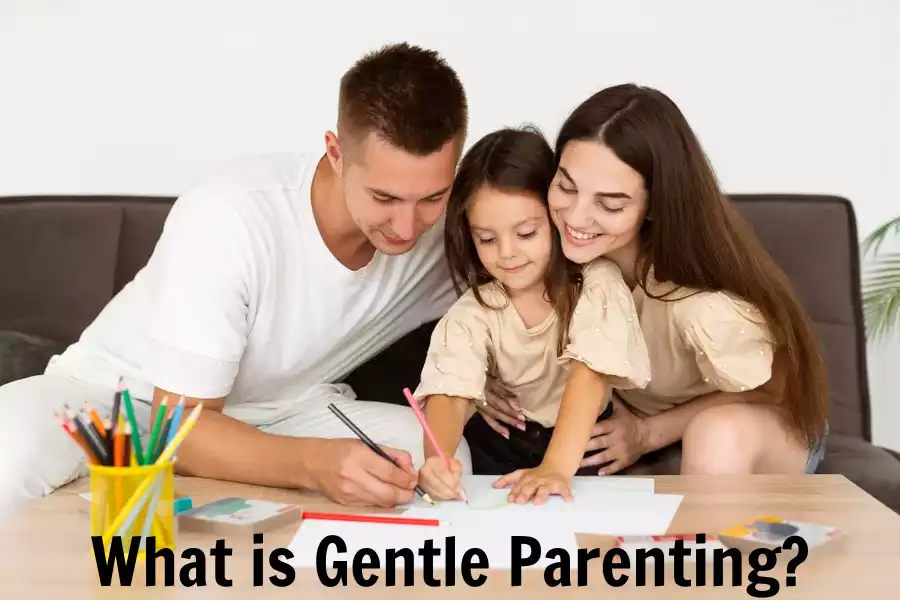
Every parent wants to raise a confident, kind, and emotionally secure child. But when your toddler is in the middle of a meltdown or your preschooler refuses to listen, the instinct to shout or threaten can feel almost automatic. Gentle parenting offers a different path, one built on empathy, respect, and consistent boundaries rather than fear or punishment.
Gentle parenting is empathetic, respectful, and understanding. Mrs Sarah Ockwell-Smith wrote: “Imagine raising children where connection and empathy are the cornerstones. That’s the essence of gentle parenting. It’s about nurturing a bond with your child, understanding their emotions, and working together to find solutions. It’s not about being perfect, but about creating a loving and supportive environment where your child can thrive.“
In this article, we cover what gentle parenting actually means, how it differs from permissive parenting, its real-world pros and cons, and practical steps for applying it at home.
1. What is gentle parenting?
Gentle parenting is one of the philosophies of raising children. In this case, parents avoid punishment techniques like time-outs and removing privileges. They focus on an outline of positive behaviors to encourage good behavior. The American Academy of Pediatrics (AAP) suggests this to pediatricians, they say that discipline is teaching, not punishment. It makes children more independent, creative, and able to express themselves most confidently.
The main principle of this method was identified and introduced by child psychologist Dr. Alfred Adler in the 1920s. This is the core of gentle parenting. Children should be treated in ways that help their mental health.
One common misconception is that gentle parenting means letting children do whatever they want. It does not. Gentle parenting is not permissive parenting. It requires clear limits and consistent rules, the difference is that those limits are set with empathy and calm rather than through shame or fear.
2. What is gentle parenting? Specific aspects of parenting
Gentle parenting includes understanding, cooperation, trust, and respect, boundaries. These are also the core principles of this method:
Empathy
Empathy in gentle parenting encourages feelings of safety, compassion, and psychological well-being.
According to experts, parents often neglect their children. They don’t listen or understand them. This neglect leads to a high risk of depression in children. Therefore, with this method, the parents are prompted to listen, comprehend, and empathize with the children more

Respect
In Gentle Parenting, children and their caregivers must both show respect. One clear way to show respect in the parent-child relationship is to let the child talk. They should do so without interruption, and you should ask questions before answering. It would be absurd to teach a child to grow up to be an adult who respects others if respect is not taught from a young age. When a parent or any adult in a child’s life shows respect to them, it tells the child that respect grows over time and by example. In our daily interactions, that means not yelling at children but using phrases like ‘Please, can you…?’ when you want your child to do something instead of saying ‘I warned you!’
Understanding
Understanding is the initial approach to gentle parenting. In the words of specialists, a child’s emotions and experiences are denied, diminished, or completely overlooked. Try telling a child, ‘It is nothing’ when you know that your child is hurt or sad. This can make them feel neglected and unappreciated like their opinions and feelings do not matter at all. In gentle parenting, we consider children’s emotions when explaining their behaviors. The response should consider how the child feels.

Boundaries
Gentle parenting is a type of discipline. It describes a method of management. The method aims to promote good behavior by establishing limits. It also involves adjusting student’s behavior. However, permissive parenting does not prescribe any kind of rules. The approach is tender in a way that it requests caregivers to agree to establish boundaries and rules for the correct upbringing of the child. Specific laws may be very different in the two families. But, they can address shared concerns by discussing what is said and done, and how.
3. What is gentle parenting? Its pros and cons
The age is 7 to 13. The National Scientific Council on the Developing Child1 found it to be a very sensitive age for receiving positive or negative impacts.
Strengths (Pros) of gentle parenting
Stronger parent-child bond: Gentle parenting that focuses on empathy leads to better interactions. Research shows that children with a secure attachment to their parents explore, and act on their own. They have also grown to be more independent, strong, and confident.2
Emotional intelligence: Gentle parenting may help develop children’s emotional intelligence. It does this by acknowledging and guiding them through their feelings.
Reduced anxiety: Hypotheses advise that gentle parenting might make children feel more secure in social situations and not as stressed as their highly aggressive peers.
Positive behavior: Trying not to upset the kids and teaching them good manners is one way of ensuring they have good behavior without using the rod.
Gentle parenting also helps improve social skills by teaching empathy and emotion regulation directly.
Better academic performance: Studies show that they’ve improved children’s academic performance.

Weaknesses (Cons) of gentle parenting
- Time and energy intensive: Gentle parenting requires patience to let emotions unfold, time to communicate rather than just react, and energy to offer empathy when you are tired or stressed.
- High parental investment: The approach assumes parents can read and respond to their child’s emotional state accurately, even without formal training in child psychology.
- Risk of unclear limits: Without consistently held boundaries, gentle parenting can drift into permissiveness. Children need to know where the line is, even when it is delivered kindly.
- Parental guilt after setbacks: Because the approach sets a high bar for calm and empathy, parents who lose their patience may feel they have failed. The philosophy encourages repair after those moments, but the guilt is still real.
4. How does one incorporate gentle parenting into day-to-day?
Focus on empathy and validation: Try to be patient, and to understand what your child is trying to say to you and how they feel. We can ask them after a day of school activities. For example, ‘How was your day today?’ Recognize children’s moods and emotions. Care for them, encourage them, and help them feel comfortable.
Set clear and consistent boundaries: Make rules for each child. If they do wrong, explain why and what will happen next so they do not go wrong again. Instead of shouting “Don’t do that, it’s wrong”, say: ”If you do that what will be the repercussions and how will you endure it?”
Allows selection: Don’t force your child to take things they don’t like. Respect those preferences to promote autonomy and independence.

Model positive behavior: Children enjoy learning when examples are models they can identify easily. This means one should manage their emotions. They should also manage how they show them. This is because children are likely to copy whatever the parent does.
For instance, while walking on the road, you find a brick blocking traffic. Instead of folding your arms and looking away, you take the brick and put it elsewhere. You did that right and have made an example for your child, and he has become a different person.
Focus on solutions: Parents should help their children solve problems, they shouldn’t let the child self-destruct or do things for them. That will mend the relationship more closely
5. Is Gentle Parenting Right for Your Family?
Gentle parenting is not a prescription for perfect behavior on your part or your child’s. It is a framework that invites you to respond with curiosity rather than reaction, and to see behavior as communication rather than defiance.
What the evidence consistently shows is that children do best when they feel both understood and held to clear, predictable expectations. Whether you adopt every element of gentle parenting or adapt just a few, the core principle holds: a child who trusts their parent is more likely to cooperate, regulate their emotions, and carry those skills into adulthood.
Sources
- Larzelere R, Lindner Gunnoe M, Roberts M, et al. Children and Parents Deserve Better Parental Discipline Research: Critiquing the Evidence for Exclusively “Positive” Parenting. Marriage and Family Review. 2017;53:1,24-35. ↩︎
- Dallaire DH, Pineda AQ, Cole DA, et al. Relation of Positive and Negative Parenting to Children’s Depressive Symptoms. J Clin Child Adolesc Psychol. 2006;35(2):313-322. ↩︎