Hearing your baby say “mama” for the first time is one of those magical parenting moments you’ll never forget. But when should you expect this milestone, and is your baby on track? If you’re eagerly awaiting those precious first words, you’re certainly not alone in counting the days.
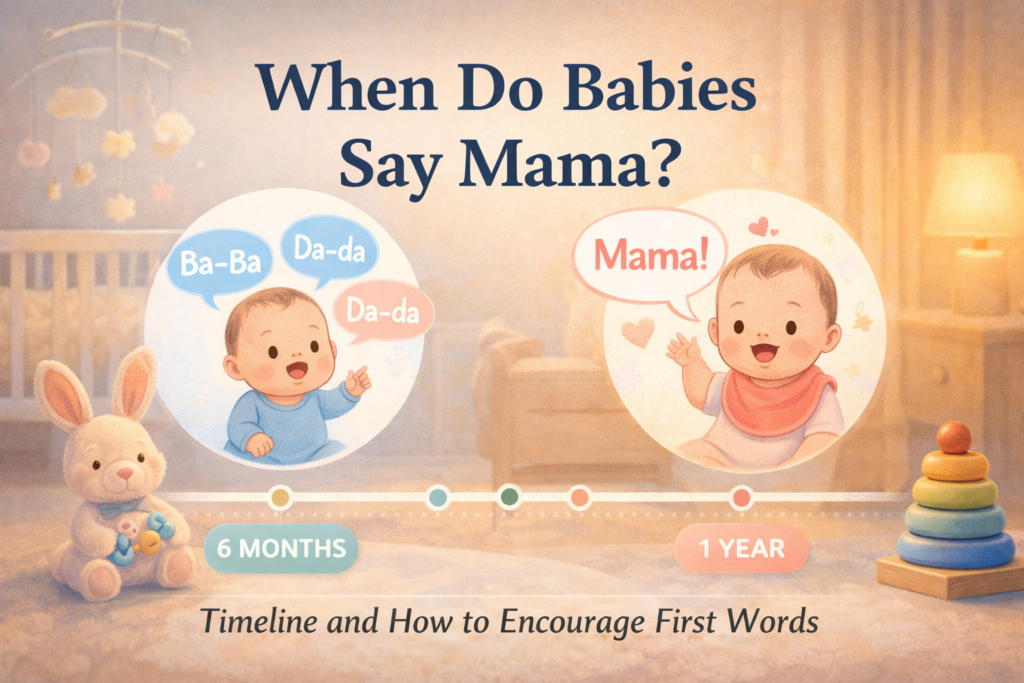
Most babies say “mama” or “dada” between 6 to 12 months, though meaningful association with parents typically develops around 9 to 14 months. Every baby develops at their own pace, so there’s a wide range of normal. Understanding your baby’s language development journey helps you know what to expect and how you can support those emerging communication skills.
In this article, you’ll discover when babies typically say “mama,” why some say “dada” first, and practical ways to encourage your baby’s first words. Rest assured, whether it takes 8 months or 14 months, your baby’s first “mama” will be worth the wait.
Understanding Baby Language Development Stages
Before your baby says their first recognizable word, they go through several important stages of communication development. Understanding these stages helps you appreciate each step of the journey toward that magical “mama.”
Birth to 3 Months: Crying and Cooing
From their very first breath, babies communicate through crying. This is their primary way of expressing needs for food, comfort, or attention. During these early weeks, you might also notice other newborn behaviors like grunting and squirming while sleeping, which is completely normal as babies adjust to life outside the womb and their digestive systems develop.
Within the first month, you’ll start hearing sweet cooing sounds as your baby begins experimenting with their vocal cords.
These early coos — soft vowel sounds like “oooh” and “aaah” — are your baby’s first attempts at communication beyond crying. While not yet words, these sounds represent crucial practice for the speech muscles and breathing coordination needed for talking.
4 to 7 Months: Babbling Begins
Around 4 to 7 months, babies enter the babbling stage, where they start combining consonants with vowels. You’ll hear repetitive syllables like “babababa” or “dadadada.” This babbling serves as important practice for the tongue, lip, and jaw movements required for actual speech.
Important distinction: When your 6-month-old repeats “mamama” or “dadada,” they’re not actually saying “mama” or “dada” yet — they’re just exploring sounds. These are random syllables that happen to sound like words, but don’t have meaning attached.
8 to 9 Months: Understanding Emerges
Around 8 to 9 months, babies begin understanding words and language, even if they can’t yet produce many words themselves. They may respond to their name, understand “no,” and recognize familiar words like “bottle” or “bath.” This comprehension precedes the ability to speak by several months.
At this stage, your baby might start attempting to say “mama” or “dada,” but they likely don’t yet connect these sounds to you. They may say “mama” while looking at anyone — you, dad, or even the family dog.
10 to 14 Months: True First Words
Between 10 and 14 months, most babies speak their first true words with meaning. This is when “mama” stops being random babbling and becomes your baby intentionally calling for you. They look directly at you when they say it, use it when they want you, and clearly understand that “mama” means you.
This is the milestone to celebrate — when your baby not only says “mama” but truly means it. According to pediatricians, this meaningful use of “mama” or “dada” typically emerges around the one-year mark, though some babies reach this milestone earlier or later.
When Do Babies Say “Mama” With Meaning?
The answer depends on whether you’re counting babbling or true speech:
Babbling “mamama” sounds: 6-9 months
Saying “mama” as a recognizable attempt: 8-12 months
Using “mama” meaningfully to refer to you: 9-14 months
Most common age for meaningful “mama”: 10-12 months
By their first birthday, approximately 90% of babies can use at least one word meaningfully, and “mama” or “dada” is often that word. If your baby isn’t saying any words by 15 months, it’s worth discussing with your pediatrician, though many perfectly normal babies take a bit longer.
Why Do Babies Often Say “Dada” Before “Mama”?
If your baby’s first word was “dada” instead of “mama,” you’re in good company. Research shows that “dada” is typically the more common first word across multiple languages and cultures. But before you take this personally, understand that it’s not about preference — it’s about linguistics and development.
The “D” Sound Is Physically Easier
Many speech-language pathologists point out that both “m” and “d” sounds are early developing consonants produced at the front of the mouth. However, the “d” sound may have a slight advantage.
When a baby’s mouth is at rest with their tongue near the roof of their mouth, making the “da” sound comes more naturally. Babies who suck their thumbs or use pacifiers have their tongues already positioned perfectly for the “d” sound. In contrast, the “m” sound requires babies to consciously bring their lips together and push air through their nose — a slightly more complex motor task.
Frequency Matters: What Babies Hear Most
Another factor is simple exposure. If you’re the primary caregiver home with your baby all day, you might frequently say “Dada’s coming home!” or “Look, it’s Dada!” You’re unlikely to talk about yourself in the third person as often, meaning your baby hears “dada” more frequently than “mama”.
This doesn’t reflect a stronger bond with dad — it’s simply about repetition and reinforcement. When babies experiment with sounds and accidentally say “dada,” the excitement and attention they receive reinforces that sound, encouraging them to repeat it.
The Mother-Baby Fusion Theory
Some child development experts propose a fascinating psychological reason: babies are so deeply bonded with their primary caregiver (often mom) that they initially don’t see themselves as separate. From your baby’s perspective, you and they are one unit.
The first person a baby recognizes as separate from themselves is often their father. Therefore, “dada” becomes the first person they name. When they eventually say “mama,” it represents a developmental leap — recognizing that mom is a distinct person. This means saying “dada” first actually indicates a strong mother-baby bond, not a weaker one.
How to Help Your Baby Say “Mama”
While you can’t force your baby to speak before they’re developmentally ready, you can create an environment that encourages language development and makes “mama” more likely to be among their first words.
Talk in the Third Person
Babies don’t understand pronouns like “I,” “me,” “you,” or “she” until much later. When you say “I’m going to feed you,” your baby doesn’t connect “I” with you. Instead, use your parental name: “Mama’s going to feed you” or “Mama has your bottle.”
This helps your baby associate the word “mama” directly with you. Do this consistently throughout daily routines: “Mama’s changing your diaper,” “Look at Mama!” or “Mama loves you.”
Exaggerate the “M” Sound
Make the “m” sound fun and engaging in everyday situations:
- When eating: “Mmmmm, yummy!”
- During kisses: Make exaggerated “mmmwah” sounds
- While looking in mirrors: Point to yourself and say “Mama!” while touching your lips
- During play: Hum and make “mmm” sounds to draw attention to the lip movement
Being animated and playful with the “m” sound helps your baby notice how to produce it and makes practice enjoyable rather than pressure-filled.
Practice Face-to-Face Interaction
Position yourself at your baby’s eye level during conversations, feedings, and play. This allows your baby to watch your mouth movements as you speak, which is crucial for learning how to form sounds.
Make eye contact, speak slowly and clearly, and pause to give your baby a chance to respond. Even if they just coo or babble back, this turn-taking is an important foundation for conversation.
Read Books Featuring “Mama”
Find board books that repeat the word “mama” frequently. Books like “Mama Loves You” or similar titles that emphasize parental names can reinforce the word through repetition and context.
Point to pictures in the book and say “That’s a mama” or “Look, the baby is calling for mama” to help your baby understand the word’s meaning.
Create a Photo Book
Make a simple photo album using pictures of family members with labels. Include multiple photos of you with the word “Mama” beneath each one. Look at this book together regularly, pointing to pictures while saying “Mama!” This creates a clear visual association.
Avoid High-Pressure Tactics
The most important advice: keep it fun and low-pressure. If your baby senses anxiety or expectation every time you say “mama,” they may actually resist saying it. Language development thrives in a relaxed, playful environment.
Don’t repeatedly test your baby by demanding “Say mama!” or expressing disappointment when they don’t. Instead, model the word naturally throughout your day and trust that it will come when they’re ready.
Supporting Overall Language Development
Beyond encouraging “mama” specifically, you can support your baby’s general language skills:
Talk constantly throughout the day: Narrate what you’re doing, describe objects around you, name body parts, and share your thoughts. This language-rich environment gives your baby thousands of words to absorb.
Read together daily: Even young babies benefit from reading time. Choose colorful board books with simple text and read with expression. Don’t worry if your baby just wants to chew on the book — they’re still absorbing language from your narration.
Sing songs and nursery rhymes: Music naturally attracts babies’ attention and helps them learn language patterns, rhythm, and new vocabulary. Songs with repetitive phrases are especially helpful.
Limit screen time: The American Academy of Pediatrics recommends no screen time for babies under 18 months (except video chatting with family). Real human interaction is essential for language development, and screens cannot replace it.
Respond to all communication attempts: When your baby coos, babbles, or makes sounds, respond enthusiastically. This back-and-forth “conversation” teaches your baby that communication gets results and encourages them to keep trying.
Use simple, clear language: While you don’t need to use only baby talk, simplifying your language helps. Use short sentences with clear enunciation, and repeat important words multiple times.
Individual Differences: When Variation Is Normal
It’s crucial to remember that language development follows a wide range of normal. Some babies are early talkers who clearly say “mama” by 8 months. Others are late bloomers who don’t speak their first word until 14 or even 16 months. Just as each baby has their own timeline for saying “mama,” they also reach other milestones at different paces—from when the newborn stage ends to when they start walking or sleeping through the night.
Several factors can influence timing:
Bilingual exposure: Babies learning two languages simultaneously may speak slightly later because they’re processing two language systems. This is completely normal and doesn’t indicate any problem — they’ll eventually speak both languages well.
Personality and temperament: Some babies are naturally more talkative and experimental with sounds, while others are more observant and cautious. Quieter babies may say less but understand just as much.
Birth order: Second and third children sometimes talk later than firstborns because older siblings “translate” for them, reducing their need to speak. They may also get less one-on-one conversation time.
Hearing ability: Babies with undiagnosed hearing issues may have delayed speech. If you have concerns about your baby’s hearing, discuss screening with your pediatrician.
Individual development pace: Just as some babies walk at 9 months while others wait until 15 months, language development varies. These variations don’t predict intelligence or future language ability.
When to Seek Professional Advice
While variation is normal, certain signs warrant a conversation with your pediatrician or a referral to a speech-language pathologist:
- No babbling by 8-9 months: Babies should be making repetitive consonant-vowel sounds like “bababa” by this age
- Not responding to their name by 9 months: This could indicate hearing issues or developmental delays
- No meaningful words by 15 months: Most babies should have at least one true word by this point
- Fewer than 10 words by 18 months: This is below typical development and should be evaluated
- Loss of previously acquired language skills: If your baby was saying words and then stopped, discuss this with your doctor immediately
- No gestures by 12 months: Babies should be pointing, waving, or nodding by their first birthday
- Not understanding simple instructions by 18 months: By this age, babies should comprehend basic requests like “Come here” or “Get the ball”
Early intervention makes a significant difference for speech delays, so don’t take a “wait and see” approach if you have genuine concerns. Trust your parental instincts — if something feels off, seek guidance.
The Broader Language Development Picture
Remember that “mama” is just one word in an explosion of language that’s coming. After those first few words, your baby’s vocabulary will grow rapidly. By 18 months, most toddlers have 10-20 words. By age 2, they may have 50-200 words and start combining them into two-word phrases like “more milk” or “mama gone.”
The foundation you’re building now — through conversation, reading, and responsive communication — supports not just first words but all future language development. Every interaction matters, from diaper changes to meals to bedtime routines.
Frequently Asked Questions
What if my baby says “dada” but not “mama” at 12 months?
This is very common and not a cause for concern. “Dada” often comes first for the linguistic and developmental reasons explained above. If your baby is saying “dada” with meaning, “mama” typically follows within a few weeks to months. Continue modeling “mama” naturally without pressure.
Can I use sign language to help my baby say “mama” sooner?
Yes! Baby sign language can actually support verbal language development. Teaching the sign for “mama” (typically tapping your thumb to your chin) while saying the word provides visual reinforcement. Many parents find that signing “mama” helps babies make the connection between the word and the meaning, though it won’t necessarily make them speak faster.
Is it normal for my baby to say other words before “mama” or “dada”?
Absolutely. While “mama” and “dada” are statistically the most common first words, some babies choose different words like “bye,” “ball,” “dog,” or “no.” First words often relate to important people, favorite objects, or social routines in your baby’s life. Any consistent, meaningful word is a wonderful milestone.
Should I correct my baby if they call other people “mama”?
Not in the early stages. When babies first learn “mama,” they may overgeneralize it to all women or even all adults. This is a normal part of learning word categories. Gently clarify by saying “That’s a lady, I’m Mama” without making it a big deal. As they develop, they’ll naturally learn to use “mama” only for you.
My baby is 14 months and only babbles — should I worry?
If your baby is babbling with different consonant sounds, responding to their name, understanding simple words, and pointing or gesturing, they’re likely on track and just need more time. However, if there’s no meaningful word use by 15 months, consult your pediatrician to rule out hearing issues or developmental delays. Early evaluation is always better than waiting.
Does the amount I talk to my baby really make a difference?
Yes, research consistently shows that babies who experience more conversation develop language skills faster and have larger vocabularies. The “30 Million Word Gap” study found dramatic differences in language exposure between families, with significant impacts on later school success. Talking, reading, and singing to your baby frequently builds crucial neural pathways for language.
Conclusion
Waiting for your baby to say “mama” can feel like forever, especially when you’re pouring so much love and care into every single day. But remember that your baby is on their own unique developmental timeline, learning at exactly the pace they need.
Whether your baby says “mama” at 8 months or 14 months, whether they say “dada” first or surprise you with “dog,” every word represents an incredible cognitive leap. They’re learning not just sounds, but the understanding that words have meaning, that they can use language to communicate wants and needs, and that they can connect with the people they love.
Keep talking, keep reading, keep singing, and keep being present. Model “mama” naturally in your daily routines without pressure or anxiety. Trust that when your baby is developmentally ready, that magical moment will come — when they look directly at you, reach their little arms toward you, and clearly call “Mama!” for the very first time.
And when it happens, it will absolutely be worth the wait.
Sources
- American Academy of Pediatrics. (2024). “Language Development: Speech Milestones for Babies”. HealthyChildren.org. https://www.healthychildren.org/English/ages-stages/baby/Pages/Language-Development-1-Year-Olds.aspx ↩︎
- Today’s Parent. (2025). “When Do Babies Say Mama and Dada?”. https://www.todaysparent.com/baby/baby-development/when-do-babies-say-mama/ ↩︎
- American Speech-Language-Hearing Association. (2024). “How Does Your Child Hear and Talk?”. ASHA. https://www.asha.org/public/speech/development/01/ ↩︎
- Nemours KidsHealth. (2024). “Communication and Your 8- to 12-Month-Old”. https://kidshealth.org/en/parents/c812m.html ↩︎
- The Bump. (2023). “When Do Babies Say Mama and Dada?”. https://www.thebump.com/a/when-do-babies-say-mama-dada ↩︎
- Care.com. (2025). “When Do Babies Say Mama or Dada? Who Comes First?”. https://www.care.com/c/do-babies-say-mama-or-dada-first/ ↩︎
- Wee Talkers. (2024). “When Do Babies Say Mama?”. https://www.weetalkers.com/blog/when-do-babies-say-mama ↩︎
- Tardif, T., et al. (2008). “Baby’s first 10 words”. Developmental Psychology, 44(4). https://psycnet.apa.org/record/2008-09238-004 ↩︎
- Today.com. (2024). “Baby’s First Words: Why Babies Say Dada Before Mama”. https://www.today.com/parents/babies/babies-dada-mama-rcna153724 ↩︎
- Therapy & Wellness Connection. (2024). “Brecksville speech therapist on why babies say dada first”. https://therapyandwellnessconnection.com/insights/why-does-baby-say-dada-first-brecksville-speech-therapist-insight/ ↩︎
- Motherly. (2025). “Why Do Babies Say Dada First?”. https://www.mother.ly/parenting/no-worries-mama-saying-dada-first-actually-means-you-baby-are-super-bonded/ ↩︎
- The Bump. (2023). “How to Help Baby Say Mama and Dada”. https://www.thebump.com/a/when-do-babies-say-mama-dada ↩︎
- Today’s Parent. (2025). “When Do Babies Say Mama and Dada?”. https://www.todaysparent.com/baby/baby-development/when-do-babies-say-mama/ ↩︎
- Wee Talkers. (2024). “Tips for Helping Your Baby Say Mama”. https://www.weetalkers.com/blog/when-do-babies-say-mama ↩︎
- American Academy of Pediatrics. (2024). “Media Use in School-Aged Children and Adolescents”. Pediatrics. https://publications.aap.org/pediatrics/article/138/5/e20162592/60349/Media-Use-in-School-Aged-Children-and-Adolescents ↩︎
- Hart, B., & Risley, T. R. (2003). “The Early Catastrophe: The 30 Million Word Gap by Age 3”. American Educator, 27(1), 4-9. ↩︎