About 1 in 3 healthy couples get pregnant within the very first month of trying. But for others, the road to a positive pregnancy test stretches to six months, a year, or even longer. So how long does it take to get pregnant, really?
The honest answer: it depends. Your age, your health, your timing, and sometimes just plain luck all play a role. But the numbers can help set realistic expectations – and knowing them can ease the anxiety that comes with waiting.
Quick answer: Most healthy couples (about 85-90%) conceive within 12 months of trying. Your monthly chance is roughly 15-25% per cycle, with age being the biggest factor.
In this guide, we break down the average timelines, explain what affects your chances, and help you figure out when it might be time to talk to a doctor.
The Average Timeline to Get Pregnant
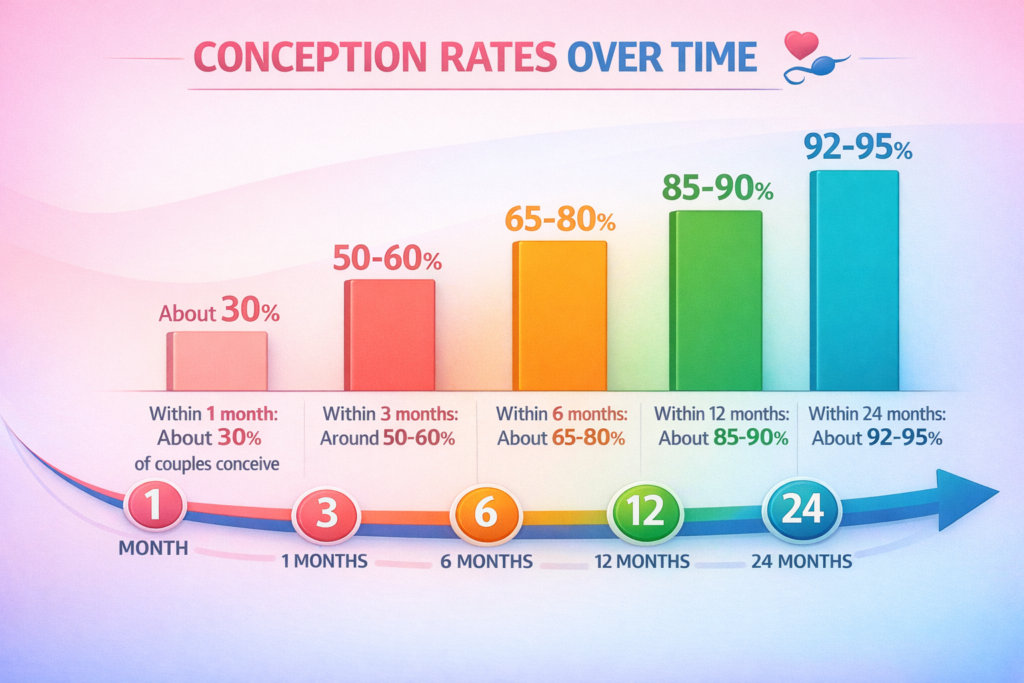
For most healthy couples having regular unprotected sex, here is what the research shows1:
- Within 1 month: About 30% of couples conceive
- Within 3 months: Around 50-60%
- Within 6 months: About 65-80%
- Within 12 months: About 85-90%
- Within 24 months: About 92-95%
In any given menstrual cycle, the chance of conception for a healthy couple is roughly 15-25%2. Doctors call this “fecundability” – the per-cycle probability of conception. It is the reason pregnancy does not always happen right away, even when everything is working perfectly.
If you are in the early months of trying, take comfort in this: most couples get there within a year. And if you have been trying for a few months without success, that is completely normal. Your body is not on a timer – it is on a probability curve.
Looking for clues that it may have worked? Check out these early signs of pregnancy before missed period that many women notice.
How Age Affects Your Chances of Getting Pregnant
Age is the single biggest factor in how long it takes to get pregnant. Women are born with all the eggs they will ever have, and both egg quantity and quality decline over time3.
Here is a breakdown of conception rates by age group4:
| Age Group | Pregnant Within 6 Cycles | Pregnant Within 12 Cycles |
|---|---|---|
| 20-24 | 57% | 71% |
| 25-27 | – | 79% |
| 28-30 | 62% | – |
| 31-33 | 61% | 77% |
| 34-36 | 56% | 75% |
| 37-39 | 46% | 67% |
| 40-45 | 28% | 56% |
A few key takeaways:
- In your 20s, fertility is at its peak. The monthly chance of conceiving is about 25%.
- In your early 30s, the odds remain strong but start to dip.
- After 35, the decline picks up speed. By 37-39, fewer than half of women conceive within six cycles.
- At 40 and beyond, the per-cycle chance drops to around 5-10%.
These numbers represent averages for women without pre-existing fertility conditions. Individual results vary widely.
Men are not immune to age-related changes either. Sperm quality, including count, motility, and morphology, tends to decline after age 40-455. Older paternal age has also been linked to longer time-to-pregnancy and a slightly higher risk of miscarriage.
For a deeper look at how your biological clock really works, read our guide on how age affects fertility in women.
Understanding Your Fertile Window
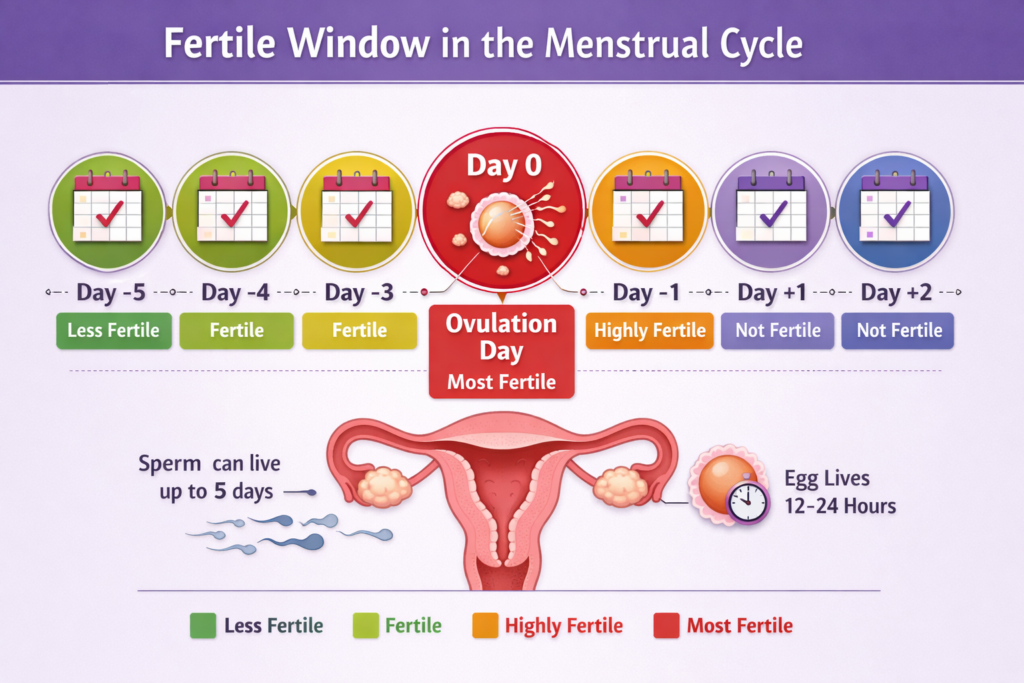
You cannot get pregnant on just any day of your cycle. There is a specific window, about six days long, when conception is actually possible6.
This fertile window includes:
- The 5 days before ovulation (because sperm can survive in the reproductive tract for up to 5 days)
- The day of ovulation itself (the egg is only viable for 12-24 hours after release)
The highest chance of conception happens when you have sex 1-2 days before ovulation. At that point, sperm are already in position and waiting for the egg.
How to Track Your Fertile Window
Several methods can help you pinpoint ovulation:
- Ovulation predictor kits (OPKs): These detect the LH surge that happens 24-36 hours before ovulation. They are the most practical option for most women.
- Basal body temperature (BBT): Your resting temperature rises slightly (about 0.2 degrees Celsius) after ovulation. Tracking over several cycles reveals your pattern.
- Cervical mucus monitoring: Around ovulation, cervical mucus becomes clear, stretchy, and slippery, often compared to raw egg whites.
- Cycle tracking apps: While not a replacement for the methods above, apps can help you log data and predict your window over time.
If you want to maximize your odds, learn more about the best time to get pregnant during ovulation.
That said, you do not need to obsess over perfect timing. The NHS recommends simply having sex every 2-3 days throughout your cycle if tracking feels stressful7. This ensures sperm are regularly available whenever ovulation occurs.
Factors That Can Delay Pregnancy
Even with good timing, several factors can make conception take longer.
Reproductive Health Conditions
- PCOS (Polycystic Ovary Syndrome): Affects ovulation and is one of the most common causes of female infertility.
- Endometriosis: Can damage fallopian tubes and affect egg quality.
- Blocked fallopian tubes: Prevents the egg and sperm from meeting.
- Thyroid disorders: Both overactive and underactive thyroid can disrupt menstrual cycles.
- Low sperm count or motility: Affects the male partner’s ability to contribute to conception.
Lifestyle Factors
- Weight: A BMI under 19 or over 30 can impair ovulation and reduce fertility in both partners.
- Smoking: Reduces fertility in women and lowers sperm quality in men. The effect is dose-dependent, meaning the more you smoke, the greater the impact8.
- Alcohol: Heavy drinking is consistently linked to reduced fertility. Research on moderate intake is mixed.
- Excessive caffeine: More than 200-300 mg per day (roughly 2-3 cups of coffee) may slightly reduce fertility.
- Stress: While “just relax” is unhelpful advice, chronic stress can affect hormonal balance and disrupt ovulation.
Coming Off Birth Control
Many couples worry that previous birth control use will delay pregnancy. The good news: research shows no long-term effects on fertility from hormonal contraception9. However, it can take a few months for your cycle to regulate after stopping the pill, and ovulation may not return immediately after removing an IUD or stopping injections like Depo-Provera.
How to Increase Your Chances of Getting Pregnant
You cannot guarantee a fast timeline, but you can give yourself the best possible odds.
- Have regular sex. Every 2-3 days, or focus on your fertile window if you are tracking ovulation.
- Track your cycle. Use OPKs or other methods to identify when you ovulate.
- Start prenatal vitamins early. Folic acid is especially important. Begin taking it at least one month before trying to conceive.
- Maintain a healthy weight. Aim for a BMI between 19 and 30.
- Quit smoking. Both partners. This is one of the most impactful changes you can make.
- Limit alcohol and caffeine. Cut back or eliminate alcohol. Keep coffee to one to two cups a day.
- Move your body. Regular moderate exercise supports fertility. Avoid extreme endurance training, which can disrupt ovulation.
- Manage stress. Mindfulness, therapy, and support groups can all help.
- Get a preconception checkup. Your doctor can identify potential issues early and make sure you are in good shape to conceive.
For more practical strategies, read our complete guide on how to increase chances of getting pregnant naturally.
When Should You See a Doctor?

If conception is not happening on your timeline, here is when experts recommend seeking professional help10:
- Under 35: After 12 months of regular, unprotected sex without pregnancy
- 35 or older: After 6 months
- 40 or older: After 3 months, or consider consulting before you start trying
See a doctor sooner if any of the following apply:
- Irregular or absent periods
- Very painful periods or chronic pelvic pain
- History of two or more miscarriages
- Known conditions like PCOS, endometriosis, or fibroids
- History of sexually transmitted infections or pelvic inflammatory disease
- Male partner has difficulty with erection or ejaculation
- Either partner has had reproductive surgery
A fertility evaluation typically starts with blood tests to check hormones and ovarian reserve, an ultrasound, and a semen analysis for the male partner. From there, your doctor can recommend next steps, whether that is medication to stimulate ovulation, IUI, IVF, or other treatments11.
Frequently Asked Questions
Can you get pregnant on the first try?
Yes. About 30% of couples conceive in their first cycle. However, it is equally normal for it to take several months.
Does stress really affect fertility?
Chronic, severe stress can disrupt hormonal balance and delay ovulation. Occasional stress is unlikely to prevent pregnancy. Manage stress for your overall well-being, not solely as a fertility strategy.
How long after stopping birth control can you get pregnant?
Most women can conceive within one to three months after stopping hormonal birth control. Fertility typically returns with your first ovulation, though it may take longer after injectables like Depo-Provera.
Is it normal to take a year to get pregnant?
Absolutely. About 85-90% of couples conceive within 12 months, which means roughly 1 in 10 healthy couples will need more time. Doctors do not consider it a concern for women under 35 until after a full year of trying.
The Bottom Line
How long does it take to get pregnant? For most couples, somewhere between one month and one year. The average is about three to six months, but there is a wide range of normal.
Your age, health, timing, and a bit of biological luck all play their parts. The most important things you can do are understand your cycle, take care of your body, and be patient with the process.
If the timeline stretches beyond what the guidelines suggest for your age, there is no shame in reaching out to a fertility specialist. The sooner you get answers, the sooner you can move forward, whatever that path looks like for you.
This article is for informational purposes only and does not replace professional medical advice. If you have concerns about your fertility, consult your healthcare provider.
- NHS UK, “How Long Does It Usually Take to Get Pregnant,” https://www.nhs.uk/pregnancy/trying-for-a-baby/how-long-it-takes-to-get-pregnant/
- American College of Obstetricians and Gynecologists (ACOG), “Evaluating Infertility,” https://www.acog.org/womens-health/faqs/evaluating-infertility
- Your Fertility (Australia), “Age and Fertility,” https://www.yourfertility.org.au/everyone/age
- BabyCenter, “Your Age and Fertility: Chances of Getting Pregnant by Age,” https://www.babycenter.com/getting-pregnant/fertility/age-and-fertility-getting-pregnant-in-your-20s-and-30s_1494695
- Tommy’s, “Male Fertility,” https://www.tommys.org/pregnancy-information/planning-a-pregnancy/fertility-and-causes-of-infertility/male-fertility
- Johns Hopkins Medicine, “Calculating Your Monthly Fertility Window,” https://www.hopkinsmedicine.org/health/wellness-and-prevention/calculating-your-monthly-fertility-window
- NHS UK, “How to Get Pregnant,” https://www.nhs.uk/pregnancy/trying-for-a-baby/how-to-get-pregnant/
- Mayo Clinic, “Female Infertility: Risk Factors,” https://www.mayoclinic.org/diseases-conditions/female-infertility/symptoms-causes/syc-20354308
- Natural Cycles, “How Long Does It Take to Get Pregnant After Birth Control,” https://www.naturalcycles.com/cyclematters/how-long-does-it-take-to-get-pregnant
- Cleveland Clinic, “When to See a Fertility Specialist,” https://my.clevelandclinic.org/health/articles/when-to-see-a-fertility-specialist
- ACOG, “Evaluating Infertility,” https://www.acog.org/womens-health/faqs/evaluating-infertility


![[variety of unsafe pregnancy foods including raw sushi deli meat soft cheese and raw eggs on a kitchen counter]](https://babiesparent.com/wp-content/uploads/2026/03/1_Unsafe_pregnancy_foods_202603301142-768x429.webp)