Starting solids feels like a milestone the moment your baby turns six months, and baby led weaning gives families a way to skip the puree stage entirely. Instead of spoon-feeding, you set soft finger foods on the tray and let your baby do the work of grabbing, mouthing, and swallowing on their own terms. The research base behind this approach has grown considerably in the last decade, and pediatric groups including the American Academy of Pediatrics now treat self-feeding at six months as a normal first-foods path.
This guide walks through what baby led weaning actually looks like at six months: how to tell your baby is ready, which foods to start with, how to cut them safely, and how to read the difference between a baby learning to chew and a baby in real trouble. It is written for parents who want a clear starting point without skimming through forty paragraphs of background.
What Baby Led Weaning Means at 6 Months
Baby led weaning, sometimes shortened to BLW, is a method of starting solids where you offer your six-month-old soft pieces of family food and let them feed themselves. The term was popularized by Gill Rapley and Tracey Murkett in 2009, and it has since become one of the most common alternatives to traditional spoon-fed purees. Breast milk or formula remains your baby’s primary nutrition through the first year. The solid food sits alongside those feeds rather than replacing them. At six months, the goal of every meal is exposure and practice, not calories. Most babies eat almost nothing for the first few weeks and that is exactly what should happen.
Signs Your 6-Month-Old Is Ready
Six months is the earliest age pediatricians recommend introducing solids, and even at that point your baby needs to show specific developmental signs before you start. Starting earlier than six months is not advised because the digestive and immune systems need that time to mature. If your baby turned six months yesterday but still struggles to sit up, wait a few more weeks.
Look for all four of these readiness markers before the first meal:
- Sits up independently with steady head and neck control
- Has lost the tongue-thrust reflex, so food no longer gets pushed straight back out
- Brings toys or other objects to the mouth on their own
- Shows interest in what you are eating, reaching for food on your plate or watching you chew
Best First Foods for a 6-Month-Old
The American Academy of Pediatrics suggests focusing on iron at this stage, because a baby’s iron stores from pregnancy run low around six months. Around that anchor you can build in protein, healthy fat, and a rotating cast of fruits and vegetables. Cook everything until it can be mashed between your thumb and finger, and start with single ingredient foods so any allergic reaction is easy to trace.
A balanced first-foods rotation looks like this:
Iron-rich starters: soft-cooked beef or pork in finger-long strips, shredded chicken or turkey, scrambled egg yolks, mashed beans or lentils, tofu, iron-fortified baby cereal.
Protein and dairy: full-fat plain yogurt, soft cheese sticks, well-flaked white fish, smooth nut butter spread thinly on toast.
Healthy fats: ripe avocado spears with the skin left on for grip, full-fat yogurt, olive oil drizzled on cooked vegetables, butter melted into mash.
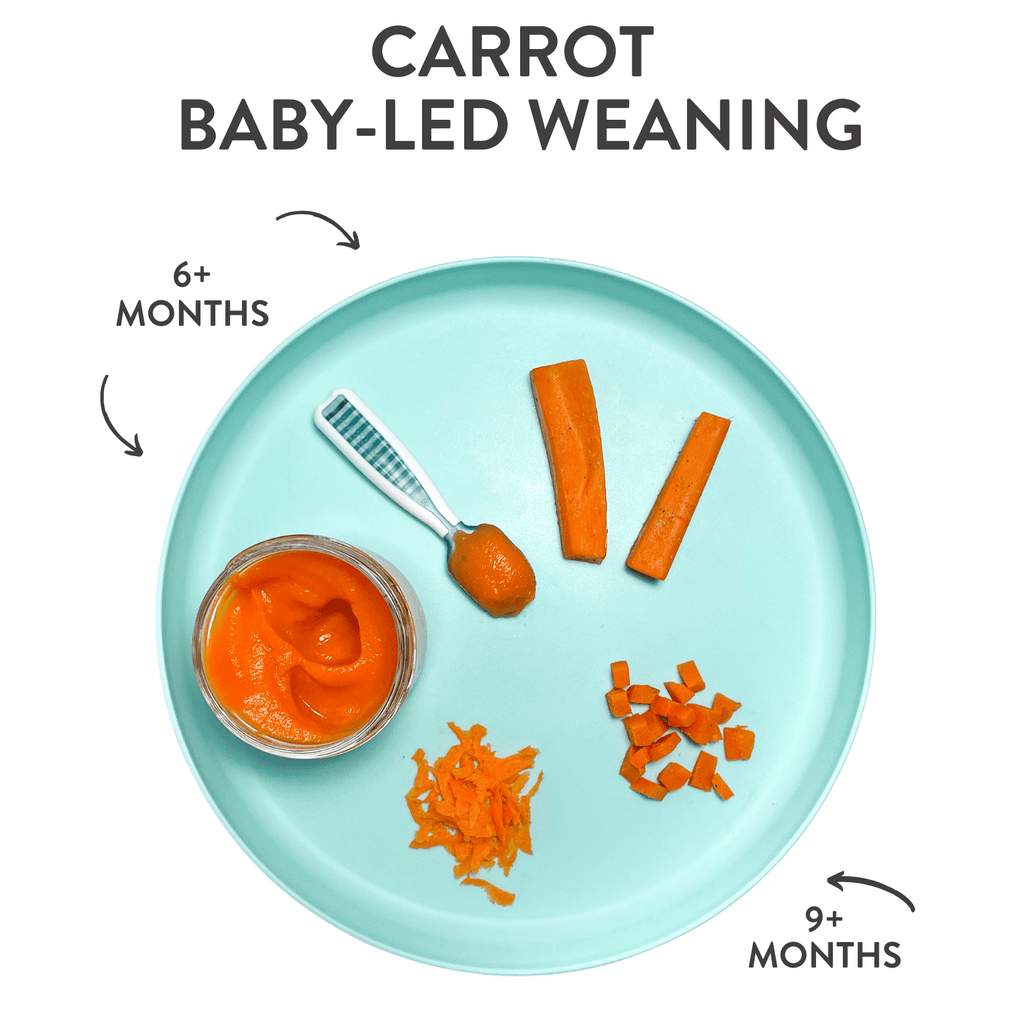
Fruits and vegetables: steamed broccoli florets, roasted sweet potato wedges, cooked carrot sticks, cucumber spears, very ripe pear or peach, banana, kiwi, watermelon. Start with less sweet vegetables like broccoli, cauliflower, and spinach if you want your baby to accept bitter flavors early.
The nine common allergens (cow’s milk, eggs, wheat, peanuts, tree nuts, fish, shellfish, soy, sesame) should be introduced one at a time around six months and offered repeatedly afterward, since early exposure lowers allergy risk according to current pediatric guidance.
How to Cut and Serve Food Safely
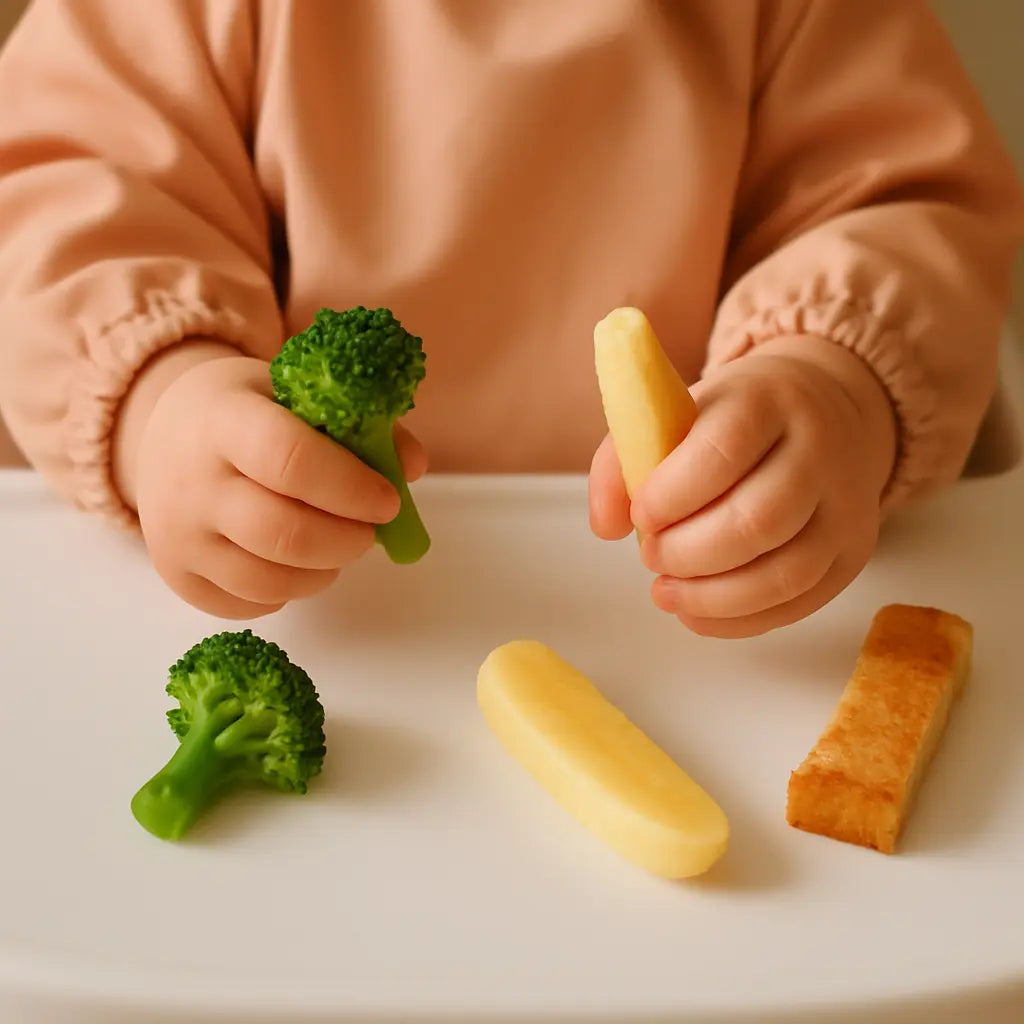
At six months, your baby grips with a closed fist. That means food needs to be large enough for the fist to wrap around with a soft tip sticking out the top. Strips about the length and width of an adult pinky finger work for most foods.
Soft enough to squish: if you cannot mash the food between your thumb and finger, it is too firm for this age. Cook root vegetables until tender, slice fruit only when very ripe, and shred or finely flake any meat.
Strips, not cubes: small round or cube-shaped pieces are harder to manage and pose more of a choking risk than long strips. Save dicing for around eight or nine months when your baby develops a pincer grasp.
Skip salt, sugar, and honey: a baby’s kidneys cannot process the sodium loads adults eat. Sugar adds nothing nutritional and crowds out better foods. Honey carries a botulism risk for any child under twelve months, even when baked into bread.
Set up a high chair where your baby’s back is straight rather than reclined, sit facing them, and offer the food about thirty minutes after a milk feed so they are interested but not ravenous.
Gagging vs Choking: Knowing the Difference
This is the question that keeps most new BLW parents awake, and the honest answer is that gagging looks alarming on purpose. The gag reflex sits much further forward in a baby’s mouth than in an adult’s, which means babies trigger it constantly when they are learning to manage textures. It is the body’s protective system at work, not a warning sign that something has gone wrong.
A true choking event looks fundamentally different from a noisy gag. The table below covers the signs that should change how you respond.
| Gagging | Choking |
|---|---|
| Airway is clear | Airway blocked or partially blocked |
| Face may turn red, eyes may water | Face and lips may turn blue or purple |
| Coughing, sputtering, retching sounds | Silent or a high-pitched wheeze |
| Baby is actively working food forward | Baby cannot dislodge the blockage alone |
| Do not intervene | Intervene with infant first aid |
Every parent practicing BLW should know infant CPR and the back-blow plus chest-thrust sequence used for babies under one year. Multiple AAP-cited studies show that babies fed with self-feeding methods do not choke more often than spoon-fed babies, but supervision is still non-negotiable.
Foods to Skip at This Age
Some foods stay off the tray entirely during the first six to twelve months, either because of choking risk or because of how a baby’s body handles them.
- Whole nuts, popcorn, and hard seeds: choking hazards no matter how the food is offered
- Round, firm pieces like whole grapes, blueberries, and cherry tomatoes: cut these in quarters lengthwise if you offer them
- Raw hard vegetables such as carrot sticks or apple slices: always cook or shred for this age
- Hot dogs or sausage in rounds: tube shapes wedge in a baby’s airway easily
- Honey of any kind, including baked into bread: infant botulism risk until twelve months
- Anything seasoned with added salt or sugar
- Cow’s milk as a drink, although it is fine cooked into dishes from six months until you switch to it as a primary milk at twelve months
A Sample Day of Eating at 6 Months
At six months, one solid meal a day is enough. There is no nutritional pressure to add a second meal until around seven to nine months. The point of that single meal is repeated practice with textures, flavors, and the mechanics of picking up food and getting it to the mouth.
A workable rhythm looks like this. Offer breast milk or formula on the usual schedule, then about thirty minutes after one of those feeds, sit down together for the solid food slot. Tuesday might be steamed broccoli florets with a strip of cooked salmon. Wednesday might be avocado spears with cooked sweet potato. Thursday might be banana, plain yogurt, and a finger of toast spread thinly with peanut butter. Each day adds one new ingredient if you are tracking allergens, and repeats one familiar food so your baby starts recognizing flavors. Photographing each tray helps you spot patterns later when you wonder which food caused that surprise rash.
Quick Answers for First-Time BLW Parents
Can you do baby led weaning at six months?
Yes. Six months is the standard starting age recommended by the AAP and the World Health Organization, provided your baby shows the readiness signs covered above.
What foods should I give my six-month-old for BLW?
Start with iron-rich soft foods cut into pinky-sized strips: avocado spears, steamed sweet potato, cooked broccoli, soft-cooked meat, mashed beans, and ripe fruit. Skip salt, sugar, and honey.
Is five months too early to start baby led weaning?
Yes. Even if your baby seems eager, the digestive and immune systems are not mature enough at five months, and the gag reflex has not fully developed for solid textures. Wait until six months and the readiness signs.
Do babies need teeth for baby led weaning?
No. Babies chew effectively with their gums as long as the food is cooked soft enough to mash between two fingers.
Starting Slow, Trusting the Process
The first few weeks of baby led weaning rarely look the way Pinterest suggests. Your baby will smear food, drop most of it, gag occasionally, and eat almost nothing for days at a stretch. That is the process working as designed. Breast milk or formula keeps the nutrition side covered while your baby learns the mechanics of eating real food. Offer the same handful of safe foods on repeat, sit across from your baby so they can mirror what you do, and resist the urge to spoon things in when the tray looks untouched. Six months is the start of a long apprenticeship, not a deadline. By the time the first birthday arrives, the baby on the receiving end of yesterday’s flying avocado will be a confident eater of family meals.