A few days before your period is due, you notice a small amount of pink or brown spotting. Is this just your period starting early? Or could it be implantation bleeding – one of the earliest possible signs of pregnancy?
If you’re currently in the two-week wait, this question can feel agonizing. The tricky part is that implantation bleeding and the start of a period can look remarkably similar. But there are real, identifiable differences – and once you know what to look for, you’ll feel a lot more equipped to read what your body is telling you.
In this article, we’ll cover what implantation bleeding actually is, how it differs from a period across six key factors, what other spotting in early pregnancy might mean, and exactly when to take a pregnancy test for the most reliable result.
One important note before we dive in: symptoms alone cannot confirm a pregnancy. The only way to know for certain is a pregnancy test. This guide is here to help you understand your body – not to replace that test.
What Is Implantation Bleeding?
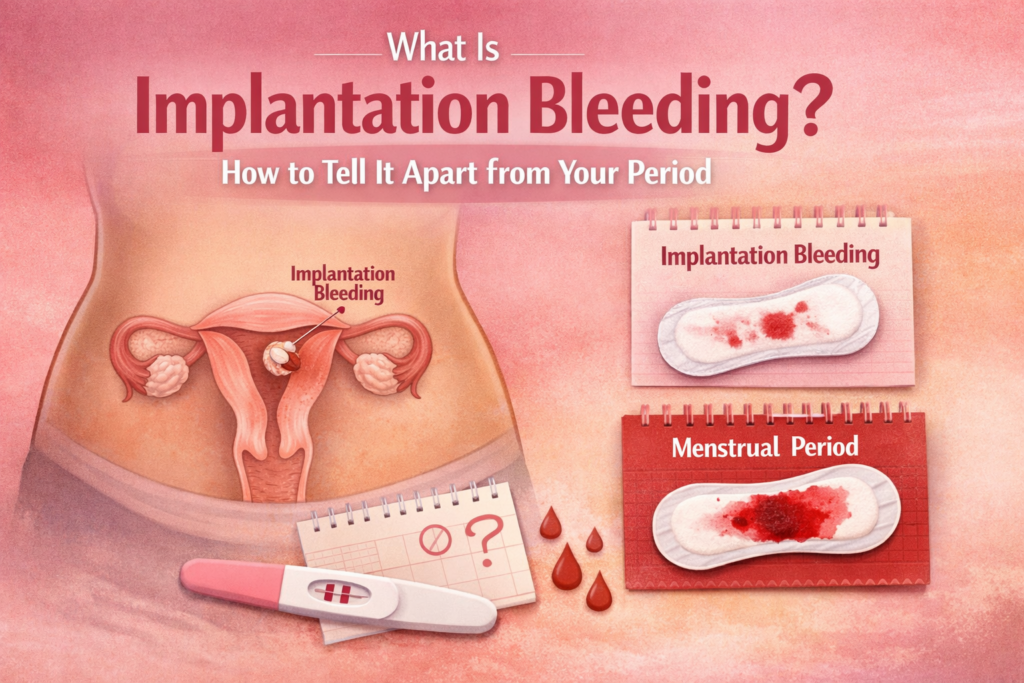
Implantation bleeding happens when a fertilized egg – now called a blastocyst – burrows into the lining of the uterus (the endometrium). As it embeds itself, it can disrupt small blood vessels in the uterine wall, causing a small amount of blood to release.
This process typically occurs 7 to 14 days after conception – which, depending on your cycle, often falls right around the time you’d expect your period. That’s the core reason these two events are so commonly confused.
Not every pregnant woman experiences it. Research suggests implantation bleeding occurs in roughly 15 to 25% of pregnancies1, though some estimates put it closer to 1 in 3. If you’re pregnant and don’t experience any spotting, that’s completely normal too.
Implantation Bleeding vs Period: 6 Key Differences
This is the heart of what most people are searching for – a clear, side-by-side look at what separates implantation bleeding from a menstrual period.
1. Color
This is often the single most telling clue.
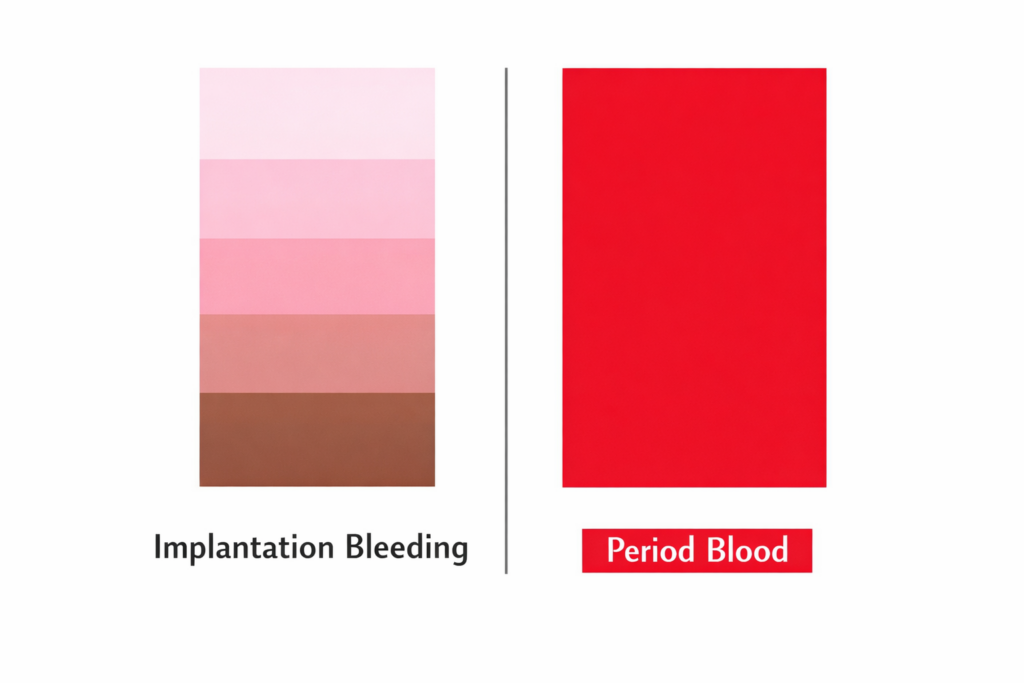
Implantation bleeding: Light pink, brown, or dark rust-colored. The blood has typically oxidized (aged slightly) by the time it exits the body, giving it that characteristic brownish or dull pink tone. Critically, it does not progress to become bright red.
Period blood: Typically starts light (sometimes pink or brown at the very beginning), then becomes bright red or dark red during the heaviest flow days, and fades back to dark brown or pinkish toward the end as the uterine lining finishes shedding2.
Key tell: If the blood stays in the pink-to-brown range throughout and never turns bright red, it’s more likely to be implantation bleeding.
2. Flow (Amount)
Implantation bleeding: Very light – often just enough to notice on toilet paper, or a faint stain on underwear. At most, it may require a panty liner. It will not soak through a pad or tampon3.
Period: Starts relatively light, then becomes progressively heavier over the first 1-2 days before tapering off. On heavy days, most people require a pad, tampon, or menstrual cup to manage flow.
Key tell: If you’re not going through any protection at all and just noticing light spotting, that points toward implantation rather than a period.
3. Duration
Implantation bleeding: Lasts from a few hours up to 1-3 days at most. It may appear and disappear intermittently rather than flowing continuously.
Period: Typically lasts 3 to 7 days, with a predictable progression from light to heavy to light again. The NHS describes a normal period range as lasting 2 to 7 days4.
Key tell: If the spotting resolves within a day or two and doesn’t build into a full flow, it’s more consistent with implantation bleeding.
4. Cramping
Implantation bleeding: May come with very mild cramping – usually a dull, faint ache in the lower abdomen or lower back. It’s brief and not severe. Many women experience no cramping at all with implantation.
Period: Cramps can range from mild to quite intense, typically build in the day before flow begins and during the first days of the period, and often last longer than implantation cramps5.
Key tell: Severe, sustained cramping that arrives alongside bleeding is much more characteristic of a period than implantation.
5. Blood Clots
Implantation bleeding: No clots. The amount of blood is simply too small, and the mechanism (small capillary disruption) doesn’t produce the clotting seen in menstruation.
Period: Clots are common, particularly during the heaviest flow days. Small clots (smaller than a quarter) are generally normal for a period; very large clots may warrant a conversation with your doctor.
Key tell: If you’re seeing clots, it’s almost certainly your period – not implantation bleeding.
6. Timing in Your Cycle
Implantation bleeding: Occurs 7 to 14 days after conception. For most women, this lands around their expected period date – or a day or two before.
Period: Arrives on a predictable schedule every 21 to 35 days. Tracking your ovulation over several cycles helps you understand your individual pattern and makes it much easier to notice when something seems different.
At a glance:
| Feature | Implantation Bleeding | Period |
|---|---|---|
| Color | Light pink, brown, rust – never bright red | Starts light, turns bright/dark red, fades to brown |
| Flow | Very light spotting – panty liner at most | Light to heavy to light again |
| Duration | A few hours to 1-3 days | 3-7 days |
| Cramping | Mild, brief, or none | Moderate to intense, sustained |
| Blood clots | None | Common on heavy-flow days |
| Timing | 7-14 days after conception, near when period is due | Every 21-35 days on cycle schedule |
What Does Implantation Bleeding Look Like in Practice?
Beyond the clinical comparisons, here’s what many women actually notice:
- A faint pinkish tint when wiping after using the bathroom
- A light spot or smear on underwear – not enough to need a pad
- Occasionally a light brownish discharge that appears, stops, then appears again briefly
- No heavy flow, no saturation of any protection
The bleeding may be intermittent rather than continuous – appearing for a few hours, stopping, then reappearing briefly. This on-and-off pattern is actually one of the hallmarks of implantation bleeding, not a typical period, which follows a more sustained and steady progression from light to heavy.
The most important thing to remember is that the spotting stays light and pinkish or brownish throughout. It doesn’t darken, intensify, or turn red.
The symptoms that sometimes accompany implantation bleeding – breast tenderness, mild bloating, fatigue, slight nausea, mood changes – overlap heavily with PMS symptoms. They cannot reliably tell you whether you’re pregnant or about to get your period. Patience and a well-timed pregnancy test are the only real tools for certainty. The early signs of pregnancy before a missed period can give you useful context, but keep in mind that every pregnancy is different – some women notice multiple early signs, while others feel nothing at all before their positive test.
Other Causes of Early Spotting
Not all spotting around the time of your expected period is implantation bleeding. A few other possibilities worth knowing about:
Cervical sensitivity: During pregnancy, the cervix becomes richer in blood flow. Intercourse, a pelvic exam, or even a Pap smear can cause light spotting that has nothing to do with implantation. This is harmless.
Subchorionic hemorrhage: A small bleed between the placental tissue and the uterine wall. More common in the early weeks of a confirmed pregnancy – often resolves on its own but should be monitored by a doctor.
Ectopic pregnancy: A fertilized egg implanting outside the uterus, usually in a fallopian tube. This is a medical emergency. Warning signs include one-sided severe pelvic or abdominal pain, shoulder tip pain, dizziness, or bleeding that escalates quickly. If you experience these symptoms, seek immediate emergency care.
Miscarriage: Bleeding from a miscarriage tends to be heavier than implantation bleeding, becomes progressively worse rather than stopping, is often accompanied by significant cramping, and may involve passing tissue or clots. If you suspect a miscarriage, contact your healthcare provider right away6.
Unexplained first-trimester spotting: Many women spot in the first trimester with no identifiable cause. In many of these cases, the pregnancy continues without any complications. However, any bleeding during a confirmed pregnancy should always be reported to your doctor.
When to Take a Pregnancy Test
Once spotting has occurred – whatever the cause – many women’s next question is the same: should I test now? The short answer is: not yet.
Timing matters more than most people realize. Taking a pregnancy test during or immediately after implantation bleeding frequently results in a false negative – even if you are pregnant.
Here’s why: pregnancy tests detect human chorionic gonadotropin (hCG), a hormone the body only begins producing after a fertilized egg implants. Right at the moment of implantation, hCG levels are still extremely low – often below the detection threshold of a standard home test. From that point, hCG roughly doubles every 48 hours in a healthy early pregnancy7.
For the most reliable results:
- Wait until the first day of your missed period – this is the optimal window for standard home tests
- If you can’t wait that long, test at least 3-5 days after the spotting stops
- Use first-morning urine for the highest hCG concentration of the day
- If the test is negative but your period still doesn’t arrive, don’t lose hope – retest in 2-3 days. hCG levels continue rising, and what shows as negative today may be clearly positive in a few days.
Home tests vary in sensitivity. Some claim to detect hCG up to 6 days before a missed period, but accuracy at that point is significantly lower. A blood test from your doctor can detect hCG as early as 6-8 days after conception – the most sensitive option available8.
When to Call Your Doctor
Light spotting that is pink or brown, short-lived, and non-progressive is usually not a reason to panic. But there are situations where you should contact your healthcare provider promptly:
- Heavy bleeding that soaks through a pad within an hour or requires frequent protection changes
- Blood clots or grayish/tissue-like material in the blood
- Severe abdominal or pelvic pain, especially on one side (possible ectopic pregnancy – seek emergency care immediately)
- Bleeding after a confirmed positive pregnancy test – always let your provider know
- Bleeding that gets heavier rather than lighter over time
- Dizziness, fainting, fever, chills, or discharge with a foul odor
- Bleeding that continues beyond 3 days without becoming a full period
Never hesitate to call your OB-GYN or midwife with questions about early bleeding9. They have answered this question thousands of times, and getting clarity early is always the right call.

Frequently Asked Questions
Can implantation bleeding be as heavy as a period?
No. Implantation bleeding is always significantly lighter than a menstrual period. If the bleeding is heavy enough to soak through protection, it is not implantation bleeding – it’s most likely your period, or something that warrants medical attention.
How long does implantation bleeding last?
Typically a few hours to 1-3 days. It may be intermittent rather than continuous. If spotting continues beyond 3 days and doesn’t develop into a full period, take a pregnancy test and consider calling your doctor.
Can implantation bleeding be bright red?
Implantation bleeding is rarely bright red. It’s usually light pink, brown, or rust-colored. If spotting is bright red and progressively heavier, it most likely is the start of your period – or a reason to contact a doctor if you’ve already had a positive pregnancy test.
Is implantation bleeding painful?
It can be accompanied by mild, brief cramping – but many women experience no cramping at all. If you have significant, sustained pain alongside spotting, it’s more likely your period, or it may need medical evaluation.
When should I take a pregnancy test after implantation bleeding?
Wait until the first day of your missed period, or at least 3-5 days after the spotting stops. Testing too soon will likely give a false negative even if you are pregnant, because hCG levels need time to rise to detectable levels.
Final Thoughts
Implantation bleeding and the start of a period can look frustratingly similar. But the key differences – a pinkish or brownish color that never turns bright red, very light flow that doesn’t require full protection, a duration of only 1-3 days, and mild or no cramping – give you a meaningful framework for reading what your body might be telling you.
Even with all of this, it’s sometimes just not possible to know for sure until you take a test. And that’s okay. The two-week wait is genuinely hard, and the uncertainty that comes with early spotting makes it even harder. A few days of patience followed by a well-timed pregnancy test will give you the answer that no amount of symptom-reading can.
Whatever the result turns out to be, you’re doing all the right things – paying attention, staying informed, and knowing when to reach out for help.
- Cleveland Clinic – Implantation Bleeding, https://my.clevelandclinic.org/health/symptoms/24536-implantation-bleeding
- Medical News Today – Implantation Bleeding vs Period, https://www.medicalnewstoday.com/articles/implantation-bleeding-vs-period
- Healthline – Implantation Bleeding vs Period: How to Tell the Difference, https://www.healthline.com/health/implantation-bleeding-vs-period
- NHS UK – Periods, https://www.nhs.uk/conditions/periods
- American Pregnancy Association – Implantation Bleeding, https://americanpregnancy.org/getting-pregnant/early-pregnancy-symptoms/implantation-bleeding
- Tommy’s UK – Bleeding During Early Pregnancy, https://www.tommys.org/pregnancy-information/im-pregnant/early-pregnancy/bleeding-in-early-pregnancy
- Cleveland Clinic – Implantation Bleeding, https://my.clevelandclinic.org/health/symptoms/24536-implantation-bleeding
- American Pregnancy Association – Implantation Bleeding, https://americanpregnancy.org/getting-pregnant/early-pregnancy-symptoms/implantation-bleeding
- Mayo Clinic – Bleeding During Pregnancy, https://www.mayoclinic.org/symptoms/bleeding-during-pregnancy/basics/when-to-see-doctor/sym-20050636


![[variety of unsafe pregnancy foods including raw sushi deli meat soft cheese and raw eggs on a kitchen counter]](https://babiesparent.com/wp-content/uploads/2026/03/1_Unsafe_pregnancy_foods_202603301142-768x429.webp)