
More women than ever are tracking ovulation at home — but not every method tells you the same thing.
Some methods predict when ovulation is coming. Others confirm it happened. Some give you a real-time signal while the moment is unfolding. Knowing which is which changes how useful each tool actually is for your situation.
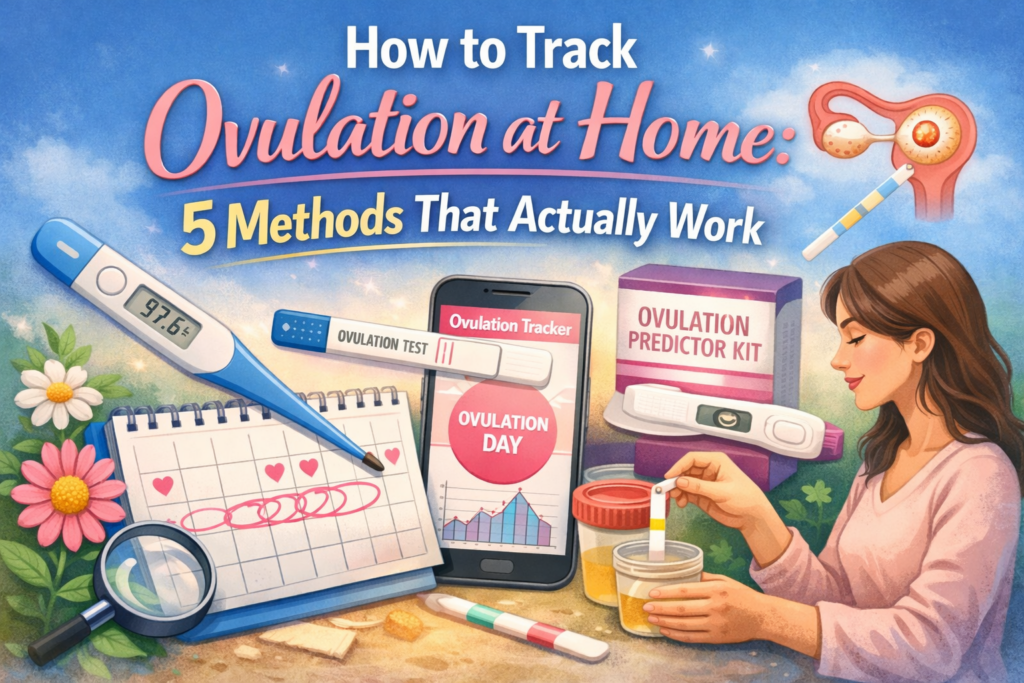
In this guide, you’ll learn how to track ovulation at home using 5 proven methods, what each one is actually best for, how to use them correctly, and how to combine them for the clearest picture of your fertile window.
Why Tracking Ovulation at Home Is Worth the Effort
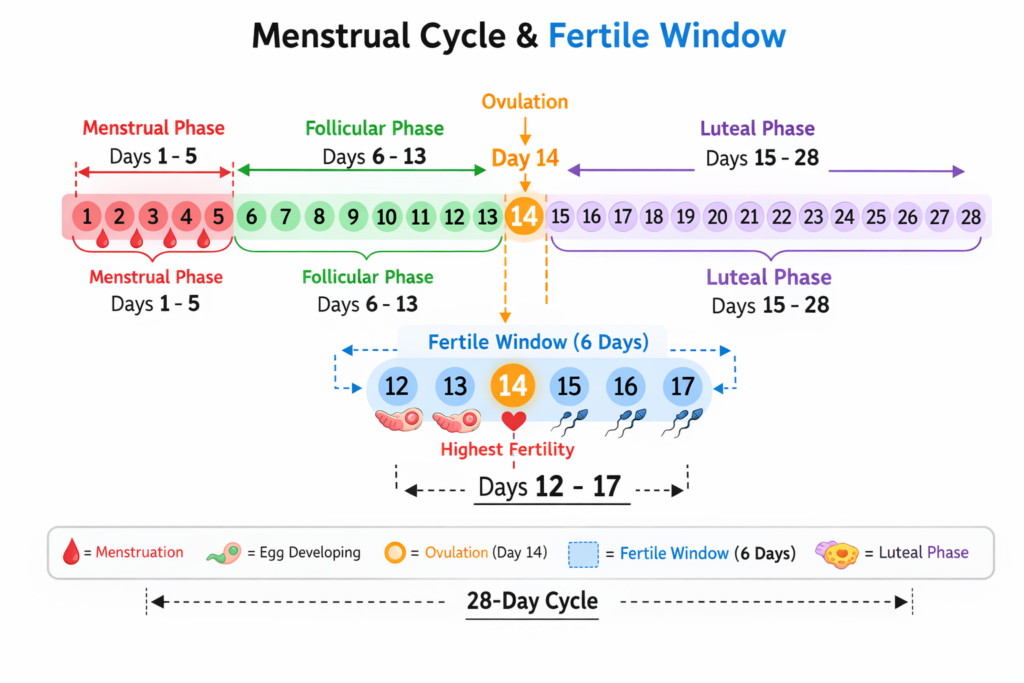
Your fertile window is shorter than most people realize. An egg is only viable for 12 to 24 hours after ovulation. Sperm, however, can survive in your reproductive tract for 3 to 5 days1. This means your best chance of conceiving comes from timing sex 1 to 3 days before ovulation — not the day of.
Calendar math alone tends to fail here: ovulation can shift by several days depending on stress, illness, travel, or natural cycle variation. Home tracking gives you personalized, real-time data about your actual cycle — not a statistical average.
Method 1: Ovulation Predictor Kits (OPKs) — Best Advance Notice
What it tells you: Ovulation is likely 12 to 36 hours away — giving you time to act.
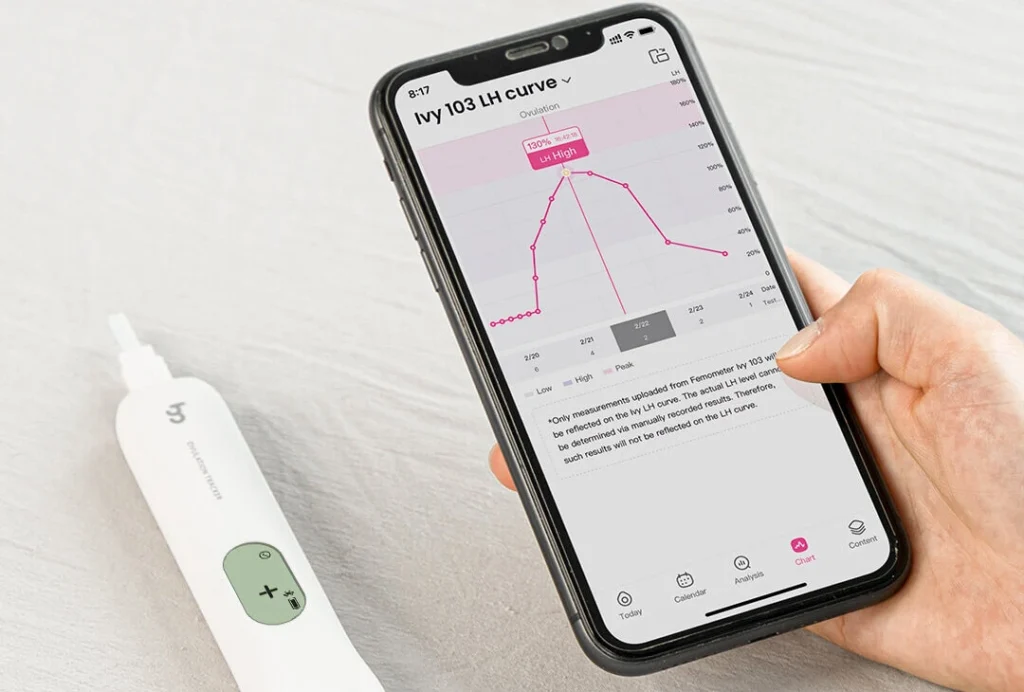
OPKs detect the LH (luteinizing hormone) surge that triggers your ovary to release an egg. A positive OPK is your clearest green light that your most fertile window is opening right now2.
How to use OPKs effectively:
- Begin testing several days before you expect to ovulate — for a 28-day cycle, start around Day 10; for shorter or longer cycles, adjust accordingly
- Test between 10 AM and 8 PM — avoid first morning urine, as LH builds through the day
- Avoid excessive fluid intake in the 2 hours before testing (which can dilute urine)
- Positive = test line as dark as, or darker than, the control line
- When positive: have sex that day and the following day
Types available:
- Strip tests — affordable and widely available; require visual interpretation
- Digital OPKs — display “peak” or “high” instead of line comparison; easier to read
- Advanced monitors (e.g., Clearblue Fertility Monitor) — detect both estrogen and LH, identifying a wider fertile window with “high” and “peak” days
Pros: Advance notice of 12–36 hours before ovulation; approximately 99% accurate at detecting LH surge
Cons: Confirms hormone surge, not egg release; women with PCOS may get false positives due to chronically elevated LH
Recognizing other physical signs alongside your OPK result gives you a more complete picture. Learning the signs of ovulation you should not ignore helps you understand what your body is doing between test results.
Method 2: Basal Body Temperature (BBT) Charting — Best for Pattern Recognition
What it tells you: Ovulation occurred — and over time, when in your cycle it tends to happen.
After ovulation, the hormone progesterone causes your resting temperature to rise by 0.4 to 1.0°F (0.2 to 0.5°C). This shift stays elevated until your next period3.
The key limitation to know upfront: BBT confirms ovulation after it happens. It doesn’t tell you in real time that ovulation is approaching in the current cycle. Its real power is in recognizing your personal timing pattern month over month.
How to chart BBT:
- Use a basal thermometer (measures to two decimal places — a regular thermometer isn’t sensitive enough)
- Take your temperature every morning before getting out of bed, before talking, eating, or drinking, after at least 3 hours of uninterrupted sleep
- Record it daily — on paper or in a fertility app
- After 2 to 3 months, you’ll see a consistent mid-cycle temperature rise that marks your typical ovulation timing
What an ovulation shift looks like: Your BBT is elevated for 3 or more consecutive days compared to the prior 6 days — this confirms ovulation has occurred.
What disrupts accuracy: illness, alcohol the night before, travel, different sleep times, restless sleep, stress — any of these can cause an irregular reading; mark those readings on your chart and don’t over-interpret them. If stress is a recurring factor in your cycle, how stress affects fertility explains the hormonal mechanisms behind it.
Pros: Free (beyond the thermometer); builds a detailed picture of your personal cycle pattern
Cons: Retrospective — cannot help you act in the current cycle until you’ve tracked several months to establish your pattern
Method 3: Cervical Mucus Observation — Free and Real-Time
What it tells you: Your fertile window is opening or near (1 to 2 days of advance notice, at no cost).
As estrogen rises before ovulation, your cervical mucus changes in texture, color, and amount in predictable ways. The appearance of egg-white cervical mucus (EWCM) — clear, slippery, and stretchy — signals that ovulation is typically 1 to 2 days away4.
The progression through your cycle:
| What You Observe | Where You Are |
|---|---|
| Dry, or no discharge | Not in your fertile window |
| Sticky or crumbly, white or yellow | Approaching fertile window |
| Creamy, lotion-like | Getting closer |
| Clear, slippery, stretchy like raw egg whites | In your fertile window — ovulation imminent |
| Returns to thick and sticky | Ovulation has passed |
How to check:
- Wipe before urinating and observe the discharge on toilet paper
- Or check your underwear throughout the day
- To test elasticity: collect a small amount on your fingertip and see if it stretches — EWCM holds together for 2 to 4 cm
Check daily, starting a few days after your period ends, to notice the progression.
Pros: Free, medication-free, provides real-time signal that complements OPKs perfectly
Cons: Takes 1 to 2 cycles to learn your personal patterns; accuracy is affected by medications, infections, arousal, and personal hygiene products
Method 4: Fertility Tracking Apps — Your Data Organizer
What it tells you: A synthesized picture of your predicted fertile window, based on the data you enter.
Fertility apps like Flo, Clue, Ovia, and Natural Cycles (FDA-cleared) let you log your period dates, BBT readings, cervical mucus observations, OPK results, and symptoms. Their algorithms then predict your upcoming fertile window and ovulation day.
The important caveat: Apps are only as accurate as the data you give them. An app predicting based on period dates alone is essentially calendar math — which can be off by several days for many women. The more data you log (especially OPK results and BBT), the more accurate and personalized the predictions become.
Which apps work best: Those that accept BBT and OPK inputs alongside period data — such as Natural Cycles, Femm, or any app with robust data entry. Apps that accept only period dates offer prediction accuracy no better than a calendar.
Pros: Convenient; helps you visualize patterns and trends across months; can sync with wearables; many include educational resources
Cons: Standalone calendar-based predictions are unreliable for irregular cycles; app quality varies significantly
Best used as: a log and organizer for your OPK, BBT, and cervical mucus data — not as a primary prediction method on its own.
Method 5: Fertility Monitors and Wearables — Comprehensive for Complex Situations
What it tells you: A broader, more data-rich picture of your fertility, particularly helpful for irregular cycles or when simpler methods aren’t giving you clear results.
Several types of home monitors are available:
- Urine-based monitors (e.g., Clearblue Fertility Monitor): measure both estrogen and LH in your urine, identifying “high fertility” days (rising estrogen) and “peak fertility” days (LH surge) — a wider window than LH-only OPKs5
- Wearable devices (e.g., Ava bracelet): worn during sleep; track skin temperature, resting pulse rate, and breathing rate to identify fertile days
- Advanced hormone monitors (e.g., Mira): measure your actual hormone curve rather than comparing to a general threshold, which can be particularly helpful for PCOS or hormonally complex cycles
Pros: High accuracy; useful when simpler methods aren’t producing clear signals; some offer both prediction and confirmation
Cons: Cost ($100 to $500+); most unnecessary for typical TTC couples who are getting clear results from OPKs and cervical mucus observation. If you’ve been tracking carefully without success, unexplained infertility — what to do next covers the next steps worth discussing with your doctor.
Combining Methods: The Symptothermal Approach
No single method tells the complete story. Combining them gives you prediction, real-time signal, and confirmation in a layered system:
| Method | What It Gives You | Advance Notice |
|---|---|---|
| Cervical mucus (EWCM) | Real-time fertile window signal | 1 to 2 days before ovulation |
| OPK (LH surge) | Clear advance notice to act | 12 to 36 hours before ovulation |
| BBT charting | Ovulation confirmation + cycle pattern | Retrospective (predicts future cycles) |
The Symptothermal Method — combining cervical mucus observation with BBT charting — is the most evidence-backed natural tracking approach, with up to 99.4% effectiveness for family planning when practiced with perfect technique.
For TTC, the most practical day-to-day combination: OPK + cervical mucus observation. When your OPK turns positive and you also notice EWCM, you’re at or approaching your peak fertile window. Have sex that day, the following day, and every 1 to 2 days while those signs continue.
Understanding exactly when the best time to get pregnant during ovulation is helps you act on these signals at the right moment in your cycle.
Which Method Is Right for Your Situation?
| Your Situation | Start Here |
|---|---|
| New to tracking, TTC with regular cycles | OPK + cervical mucus observation |
| Irregular cycles or PCOS | OPK + consider a fertility monitor |
| Want to understand your cycle over time | Add BBT charting to your routine |
| Prefer minimal active tracking | Wearable fertility monitor |
| Low budget, medication-free approach | Cervical mucus + BBT (symptothermal) |
| Already tracking — want to organize your data | Fertility app with OPK + BBT input |
Frequently Asked Questions
Is there a best method for irregular cycles?
OPKs remain useful — but for highly irregular cycles, an advanced fertility monitor (urine-based or wearable) that measures multiple hormones over time tends to give the most reliable picture. Cervical mucus observation is also less cycle-length dependent, since it responds to your hormones directly.
How accurate are OPKs?
OPKs are approximately 99% accurate at detecting an LH surge6. The important nuance: they confirm a hormone surge, not egg release itself. An LH surge without ovulation (luteinized unruptured follicle) is uncommon but does occur. Most women will find OPKs timing consistently with actual ovulation.
Can I track ovulation without any tools?
Yes — cervical mucus observation and awareness of physical ovulation signs (like Mittelschmerz and libido changes) are completely tool-free. Many fertility awareness practitioners track successfully using only these physical signs after learning the method properly. Tools like OPKs and BBT thermometers make the process faster to learn and more reliable for most people.
How long does it take to get reliable results?
OPKs and cervical mucus: useful from cycle 1, though you’ll get better at reading your signs with each cycle. BBT charting: takes 2 to 3 months to reveal your personal temperature pattern. The symptothermal method typically takes 3 to 6 months to learn well.
The Bottom Line
Tracking ovulation at home isn’t about picking the single “best” method — it’s about layering the right methods for your situation:
- OPKs: your most actionable advance warning; the place most TTC couples should start
- Cervical mucus observation: free, real-time, and pairs powerfully with OPKs
- BBT charting: retrospective confirmation that builds your cycle map over time
- Fertility apps: useful organizer when you’re already entering data from other methods
- Monitors and wearables: worth considering for irregular cycles or when simpler methods aren’t giving clear signals
Start simple. Add OPK and cervical mucus observation first. Once you’re comfortable reading those signals, adding BBT charting gives you a much richer understanding of your cycle. And when the timing is right, knowing the early signs of pregnancy before a missed period means you won’t have to wait long to read the next set of signals.
The more cycles you track, the more predictable your pattern becomes — and the clearer it becomes exactly when your fertile window opens each month. That’s the knowledge that makes a real difference when you’re trying to conceive.
If you’d also like to understand the broader lifestyle changes that can support your fertility, how to increase your chances of getting pregnant naturally covers evidence-backed steps beyond timing. Starting the right prenatal vitamins before getting pregnant is one of the earliest steps worth taking alongside your tracking routine.
This article was reviewed for medical accuracy using information from the American Pregnancy Association, Cleveland Clinic, What to Expect, Planned Parenthood, and Healthline. Always consult your healthcare provider for personalized guidance about your fertility and reproductive health.
- Cleveland Clinic. “Ovulation: When Do I Ovulate?” https://my.clevelandclinic.org/health/articles/23418-ovulation
- American Pregnancy Association. “Ovulation Predictor Kits.” https://americanpregnancy.org/getting-pregnant/ovulation-predictor-kits/
- What to Expect. “How to Track Your Basal Body Temperature.” https://www.whattoexpect.com/getting-pregnant/trying-to-conceive/basal-body-temperature-bbt-charting/
- Planned Parenthood. “What are ovulation predictor kits and fertility monitors?” https://www.plannedparenthood.org/learn/pregnancy/trying-to-get-pregnant
- Healthline. “Fertility Monitors: Types, Effectiveness, and Cost.” https://www.healthline.com/health/fertility-monitors
- American Pregnancy Association. “Ovulation Predictor Kits.” https://americanpregnancy.org/getting-pregnant/ovulation-predictor-kits/


![[variety of unsafe pregnancy foods including raw sushi deli meat soft cheese and raw eggs on a kitchen counter]](https://babiesparent.com/wp-content/uploads/2026/03/1_Unsafe_pregnancy_foods_202603301142-768x429.webp)