Your calendar says Day 14 — but has your body actually confirmed it?
For many women trying to conceive, ovulation tracking starts and ends with counting days. The problem is, ovulation doesn’t follow a calendar. It follows your hormones — and those can shift by days depending on stress, illness, or even travel.
Here’s what changes everything: your body sends clear, readable signs of ovulation before the egg is released. Learning to recognize them gives you something a calendar never can — personalized, real-time advance notice of your fertile window.
In this guide, you’ll learn the 8 ovulation signs worth paying close attention to, what each one tells you about your timing, and how to use them together to accurately pinpoint when you’re most fertile.
What Happens When You Ovulate
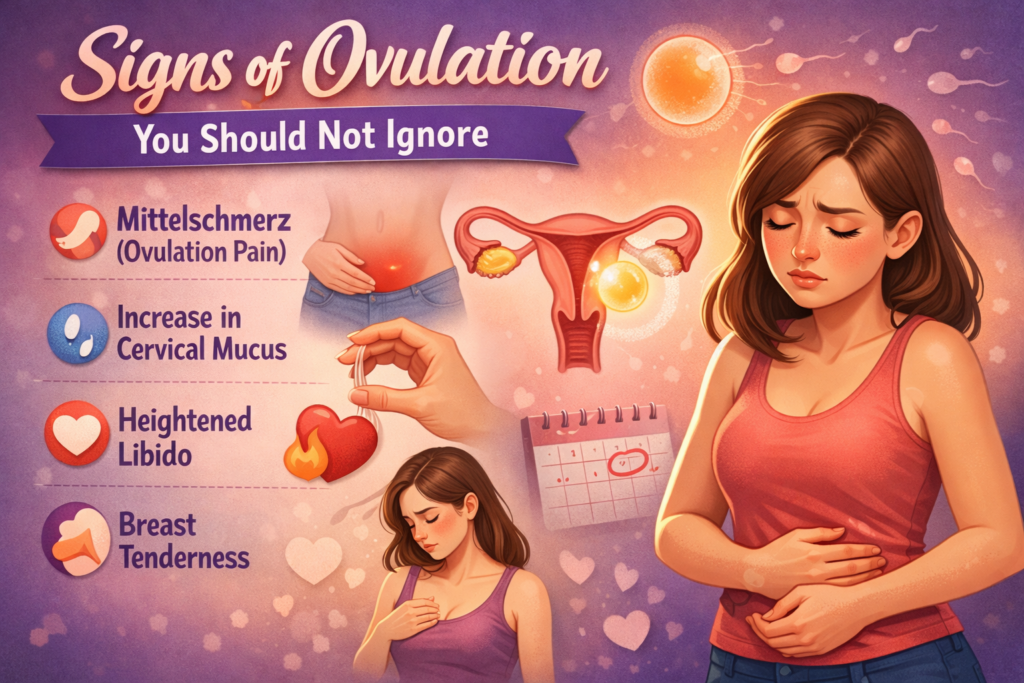
Ovulation is when a mature egg is released from one of your ovaries and begins its journey down the fallopian tube. The egg remains viable for just 12 to 24 hours after it’s released1. After that window closes, conception isn’t possible until the next cycle.
Sperm, on the other hand, can survive in your reproductive tract for 3 to 5 days. This means the most effective time to have sex is before you ovulate — so sperm are already waiting when the egg arrives.
This is why recognizing signs that ovulation is approaching — not just that it occurred — makes all the difference when you’re trying to conceive.
8 Signs of Ovulation You Should Not Ignore
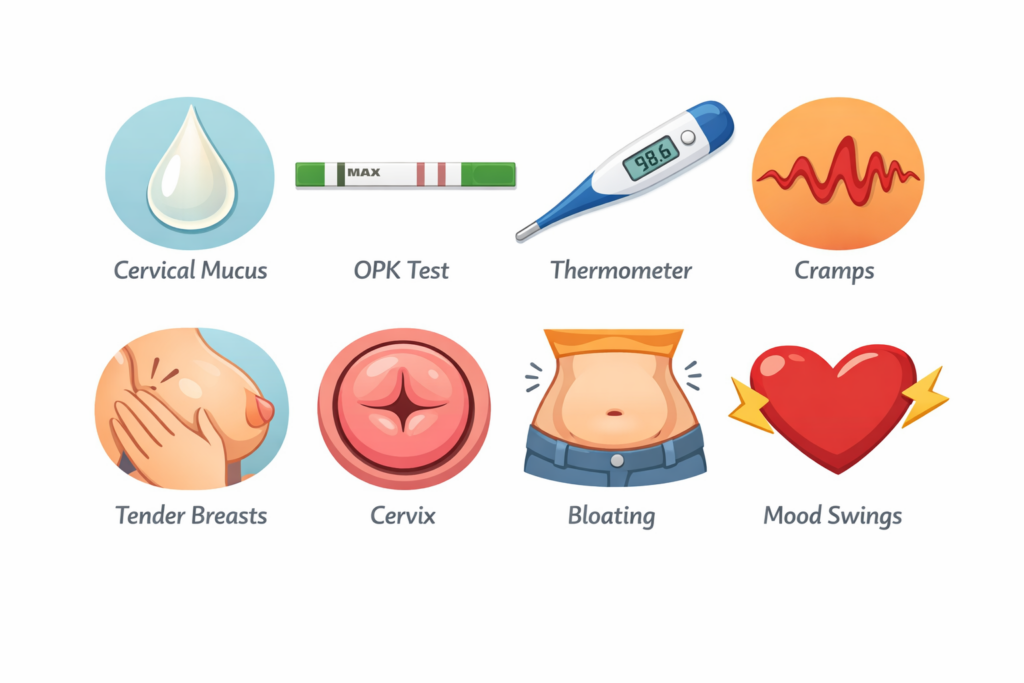
Not all of these signs appear in every woman or every cycle. But the more of them you learn to recognize, the more clearly your personal fertility pattern will emerge.
1. Changes in Cervical Mucus — Your Most Reliable Natural Signal
Cervical mucus is the single most useful sign of approaching ovulation. As estrogen rises in the days before your egg is released, the texture, color, and amount of your discharge changes in noticeable ways2.
Here’s the progression through your cycle:
| What You Notice | What It Means |
|---|---|
| Dry, or nothing at all | Not in your fertile window |
| Sticky, crumbly, white or yellow | Still outside your fertile window |
| Creamy, lotion-like | Approaching your fertile window |
| Clear, slippery, stretchy like raw egg whites | You’re in your fertile window — ovulation is 1 to 2 days away |
| Returns to thick and sticky | Ovulation has passed |
How to check: After using the toilet, wipe before urinating and observe the discharge. You can also hold a small amount between your fingers — egg-white cervical mucus (EWCM) stretches 2 to 4 cm without breaking.
When you see EWCM, that’s your clearest green light. It creates an environment that helps sperm survive and travel to meet the egg.
2. A Positive Ovulation Predictor Kit (OPK) — The Clearest Advance Warning
OPKs detect the LH (luteinizing hormone) surge that triggers ovulation. A positive test means ovulation is expected within 12 to 36 hours — giving you enough advance notice to time intercourse effectively3.
For accurate results:
- Test between 10 AM and 8 PM (avoid first morning urine — LH builds through the day)
- For a 28-day cycle, begin testing around Day 10; start earlier for longer cycles
- Positive = test line as dark as, or darker than, the control line
- Act: have sex the day of the positive and the following day
OPKs pair especially well with cervical mucus observation. When your OPK turns positive and you also notice EWCM, that’s the combination that most strongly signals your peak fertile window. Understanding the best time to get pregnant during ovulation helps you use this information at the right moment.
3. A Rise in Basal Body Temperature (BBT) — Your Confirmation Signal
Your basal body temperature (BBT) — measured first thing in the morning before any activity — rises by 0.5 to 1°F (0.3 to 0.6°C) after ovulation, driven by progesterone4. This rise typically persists until your next period.
The key distinction: BBT confirms that ovulation occurred — it doesn’t predict it in real time. Its real value is pattern recognition: after 2 to 3 months of daily charting, you’ll identify when your temperature typically shifts each cycle and can use that to plan ahead.
The symptothermal method: Combining BBT charting with cervical mucus observation is one of the most accurate natural methods of identifying your fertile window. How to track ovulation at home walks through each method in detail.
4. Ovulation Pain (Mittelschmerz) — A Real-Time Clue
Mittelschmerz is German for “middle pain” — a one-sided ache or cramp in the lower abdomen that occurs around the time of ovulation. About 40% of women experience it at some point5.
What it feels like:
- A dull ache, twinge, or occasional sharper cramp on one side of the lower pelvis
- Located on the side of the ovary releasing the egg (can alternate each month)
- Lasts anywhere from a few minutes to several hours; rarely, up to a day or two
Not everyone notices Mittelschmerz, and it’s not reliable as a sole indicator — but when you do feel it, it’s a real-time signal that ovulation is underway or just occurred.
5. Breast Tenderness or Nipple Sensitivity
Mild breast soreness or increased nipple sensitivity around ovulation is common, caused by the estrogen surge that precedes egg release6. Some women also notice ongoing tenderness into the luteal phase as progesterone rises.
The challenge: breast tenderness also appears as a PMS symptom in the days before your period. One way to distinguish them — ovulation-related tenderness typically appears around mid-cycle and is often milder, while PMS tenderness tends to be heavier and builds closer to your period.
Use this as a supporting signal, not a standalone one.
6. A Shift in Cervical Position
Your cervix changes physically throughout your cycle. Around ovulation, it becomes higher, softer, and more open — often abbreviated as SHOW (Soft, High, Open, Wet). At other times, it sits lower, feels firmer (similar to the tip of a nose), and is slightly closed.
This is a more advanced fertility awareness technique. Identifying your personal baseline takes consistent daily checking over several cycles — so if you’re just starting out, don’t worry about this one yet. It’s a layer to add as you become more familiar with your body’s patterns.
7. Bloating or Mild Pelvic Heaviness
Some women notice subtle bloating or a feeling of fullness in the lower abdomen around ovulation, caused by fluid retention from rising estrogen. It can feel like a low-grade pelvic heaviness rather than the more pronounced bloating associated with PMS.
This is a low-reliability standalone sign — easy to overlook or confuse with general cycle symptoms — but worth logging if you notice it consistently at the same point each cycle.
8. A Natural Boost in Sex Drive
In the days leading up to ovulation, rising estrogen and a small surge in testosterone naturally increase libido7. Research shows women experience more frequent sexual thoughts, heightened physical sensitivity, and greater desire for intimacy around this time.
This isn’t a coincidence — it’s a biological signal that aligns your desire with your most fertile window. If you notice an unexpected increase in libido that doesn’t quite match where you think you are in your cycle, it’s worth checking against your other signs.
How to Use These Signs Together
No single sign is completely reliable on its own. Combining two or three of them gives you a much clearer and more confident picture:
| Sign | Timing | Best Used For |
|---|---|---|
| Cervical mucus (EWCM) | 1–2 days before ovulation | Predicting fertile window |
| Positive OPK (LH surge) | 12–36 hours before ovulation | Acting on advance notice |
| BBT rise | After ovulation | Confirming and pattern-building |
| Mittelschmerz | During/just after ovulation | Real-time signal |
| Libido boost | 1–3 days before ovulation | Supporting indicator |
For TTC, the most practical combination: OPK + cervical mucus. When both align — positive OPK and EWCM present — you’re at or approaching peak fertility. Have sex that day, the following day, and every 1 to 2 days while signs continue.
Signs You May Not Be Ovulating — When to Pay Attention
Some cycles can show hormone activity without actually releasing an egg (anovulation). Signs that ovulation may not be happening include8:
- Cycles consistently shorter than 21 days or longer than 35 days
- No observable cervical mucus changes across the cycle
- OPKs that never show a positive result
- BBT charts with no temperature shift after mid-cycle
- Very light, very heavy, or absent periods
If these patterns sound familiar, it’s worth discussing with a healthcare provider. Conditions like PCOS, thyroid dysfunction, and low ovarian reserve can affect ovulation — and they’re all addressable when identified early. Alongside medical guidance, certain lifestyle habits can also help you increase your chances of getting pregnant naturally.
When to see a doctor:
- Under 35: After 12 months of regular trying without conception
- 35 or older: After 6 months
- Any age: If you have irregular cycles, PCOS, endometriosis, a history of miscarriage, or related concerns — don’t wait the full year

Frequently Asked Questions
Can you have signs of ovulation and not actually ovulate?
Yes. Some cycles produce a hormone surge — showing as a positive OPK — without releasing an egg. This is called a luteinized unruptured follicle (LUF). It’s uncommon, but if you consistently get positive OPKs without conceiving over many cycles, mention it to your doctor.
How many days before ovulation do signs appear?
Cervical mucus changes begin 4 to 5 days before ovulation, with EWCM appearing 1 to 2 days before. An LH surge on an OPK appears 12 to 36 hours before ovulation. BBT rise happens after ovulation. So depending on which sign you’re tracking, your advance notice window varies.
Can you feel ovulation every cycle?
Not necessarily. Some women reliably notice Mittelschmerz, EWCM, and libido shifts each cycle. Others rarely notice anything — which doesn’t mean they aren’t ovulating. Signs vary in intensity from cycle to cycle and between individuals. OPKs are a reliable backup when physical signs are subtle.
Is egg-white discharge always a sign of ovulation?
EWCM is the most reliable natural cervical mucus sign of approaching ovulation. However, similar-looking discharge can occasionally have other causes (arousal, certain medications, infections). Tracking it in context with the rest of your cycle confirms the pattern.
The Bottom Line
Your body gives you advance notice of ovulation — you just need to know what to look for. Here’s where to start:
- Cervical mucus: egg-white texture = fertile window open; track this every cycle
- OPK result: positive = act within 12 to 36 hours; your most actionable signal
- BBT charting: confirms ovulation happened; builds your personal cycle map over time
- Supporting signs (Mittelschmerz, libido, breast tenderness): use these to add context and confidence to your primary tracking
You don’t need to track all eight signs. Start with cervical mucus and OPKs — those two, used together, give most couples the information they need. Add BBT charting if you want to build a deeper understanding of your cycle over time.
The more cycles you observe, the more predictable your pattern becomes. And that knowledge is genuinely powerful — not just for conception, but for understanding your body on its own terms.
This article was reviewed for medical accuracy using information from the Cleveland Clinic, Mayo Clinic, NHS UK, American Pregnancy Association, Medical News Today, and Planned Parenthood. Always consult your healthcare provider for personalized guidance about your cycle and reproductive health.
- Cleveland Clinic. “Ovulation: When Do I Ovulate?” https://my.clevelandclinic.org/health/articles/23418-ovulation
- Cleveland Clinic. “Ovulation: When Do I Ovulate?” https://my.clevelandclinic.org/health/articles/23418-ovulation
- Medical News Today. “Ovulation signs: What are they?” https://www.medicalnewstoday.com/articles/327636
- Planned Parenthood. “What are the signs of ovulation?” https://www.plannedparenthood.org/learn/pregnancy/trying-to-get-pregnant
- Mayo Clinic. “Mittelschmerz.” https://www.mayoclinic.org/diseases-conditions/mittelschmerz/symptoms-causes/syc-20375122
- Medical News Today. “Ovulation signs: What are they?” https://www.medicalnewstoday.com/articles/327636
- American Pregnancy Association. “Ovulation: Frequently Asked Questions.” https://americanpregnancy.org/getting-pregnant/understanding-ovulation/
- NHS. “How can I tell when I’m ovulating?” https://www.nhs.uk/pregnancy/trying-for-a-baby/how-to-tell-when-youre-ovulating/


![[variety of unsafe pregnancy foods including raw sushi deli meat soft cheese and raw eggs on a kitchen counter]](https://babiesparent.com/wp-content/uploads/2026/03/1_Unsafe_pregnancy_foods_202603301142-768x429.webp)